Customer Expectations
A customer’s judgement of your project is a comparison, not a measurement: they form a standard before they see anything, they perceive what you delivered, and satisfaction is the gap between the two. The lecture states it as a ratio [1]:
\[\text{Customer Perception} = \frac{\text{Project Performance}}{\text{Expectations}}\]Boehm makes the same point without arithmetic [2]: “A customer expecting a 4-second response time will consider a 3-second response time a satisfying win; a customer expecting a 1-second response time will consider a 3-second capability as a disappointing loss.” Performance is identical in both halves of that sentence. Only the expectation moved.
1. The denominator has parts
Customers do not hold one number. Research identifies three levels at once [3]: the desired level they hope for, the adequate they will accept, and the predicted they think they will get. The space between them is the zone of tolerance: a delivery inside it draws no complaint.
 The three levels, and the band between the top two. [3]
Two consequences carry below. The zone moves from the bottom: almost everything a manager controls acts on the adequate line, not on what the customer wants. And for some attributes it is zero — no credit for exceeding an uptime target, only a penalty for missing it.
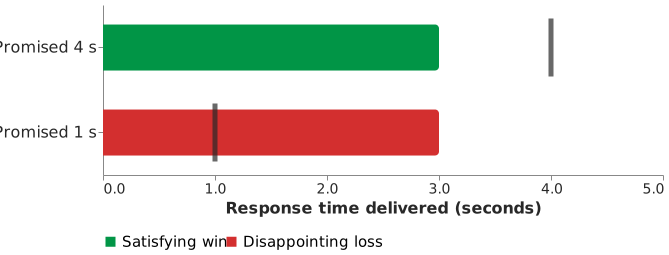 Identical performance, opposite verdicts. [2]
2. What the pages cover
| Page | The question it answers |
|---|---|
| Expectation space and solution space | What can each side actually trade? |
| Defining success | Who decides what counts as success, and when? |
| Threshold of success | How do you write that down so it can be checked? |
| Customer types | Why is a satisfied customer not a loyal one? |
| Kano classes | Why did delivering everything they asked for still disappoint them? |
| Setting expectations | What moves an expectation before the commitment? |
| Customer involvement | How much of the customer’s time should you ask for? |
The through-line: expectations move when information moves, not when arguments are won. A prototype, a task breakdown and a fortnightly demo all work the same way — each puts something in front of the customer that they can evaluate themselves.
How solid is this?
- Where it comes from. The three-level model is 17 propositions from 16 exploratory focus groups across five US service industries — insurance, equipment repair, truck rental, auto repair and hotels. There is no software in it, and the translation to software here is ours.
- What is contested. The zone of tolerance has no direct measure; the authors flag operationalising it as a difference score as problematic. Any number attached to a zone did not come from this research.
- What we do not hold. No measured effect size in software for any of these levers.
Acknowledgments
This page adapts material from lectures by Eduardo Miranda and David Root [1] on software project management.
References
- D. Root,Managing Software Development. Carnegie Mellon University / Innopolis University lecture series, 2014.
- B. Boehm, M. Abi-Antoun, D. Port, J. Kwan, and A. Lynch,“Requirements engineering, expectations management, and the Two Cultures,” in Proceedings IEEE International Symposium on Requirements Engineering (Cat. No.PR00188), June 1999, pp. 14–22. doi: 10.1109/ISRE.1999.777981.
- V. A. Zeithaml, L. L. Berry, and A. Parasuraman,“The Nature and Determinants of Customer Expectations of Service,” Journal of the Academy of Marketing Science, vol. 21, no. 1, pp. 1–12, 1993, doi: 10.1177/0092070393211001.
Disclaimer: AI is used for text summarization, polishing and explaining. Authors have verified all facts and claims. In case of an error, feel free to file an issue.