MBTI: An Example of Personality Typing
The Myers-Briggs Type Indicator sorts people into sixteen types along four preference pairs, and is the personality instrument software managers meet most often. It descends from Carl Jung, via Katherine C. Briggs and Isabel Briggs Myers.
1. The four preference pairs
Each pair asks one question; each answer contributes a letter:
- Extraverted (E) or Introverted (I) — where energy comes from: external activity, or reflection.
- Sensing (S) or iNtuitive (N) — how information arrives: through the senses, facts and detail, or through instinct and patterns.
- Thinking (T) or Feeling (F) — how decisions are made: by logic, or by personal values and empathy.
- Judging (J) or Perceiving (P) — how the outside world is met: organised and scheduled, or flexible and open-ended.
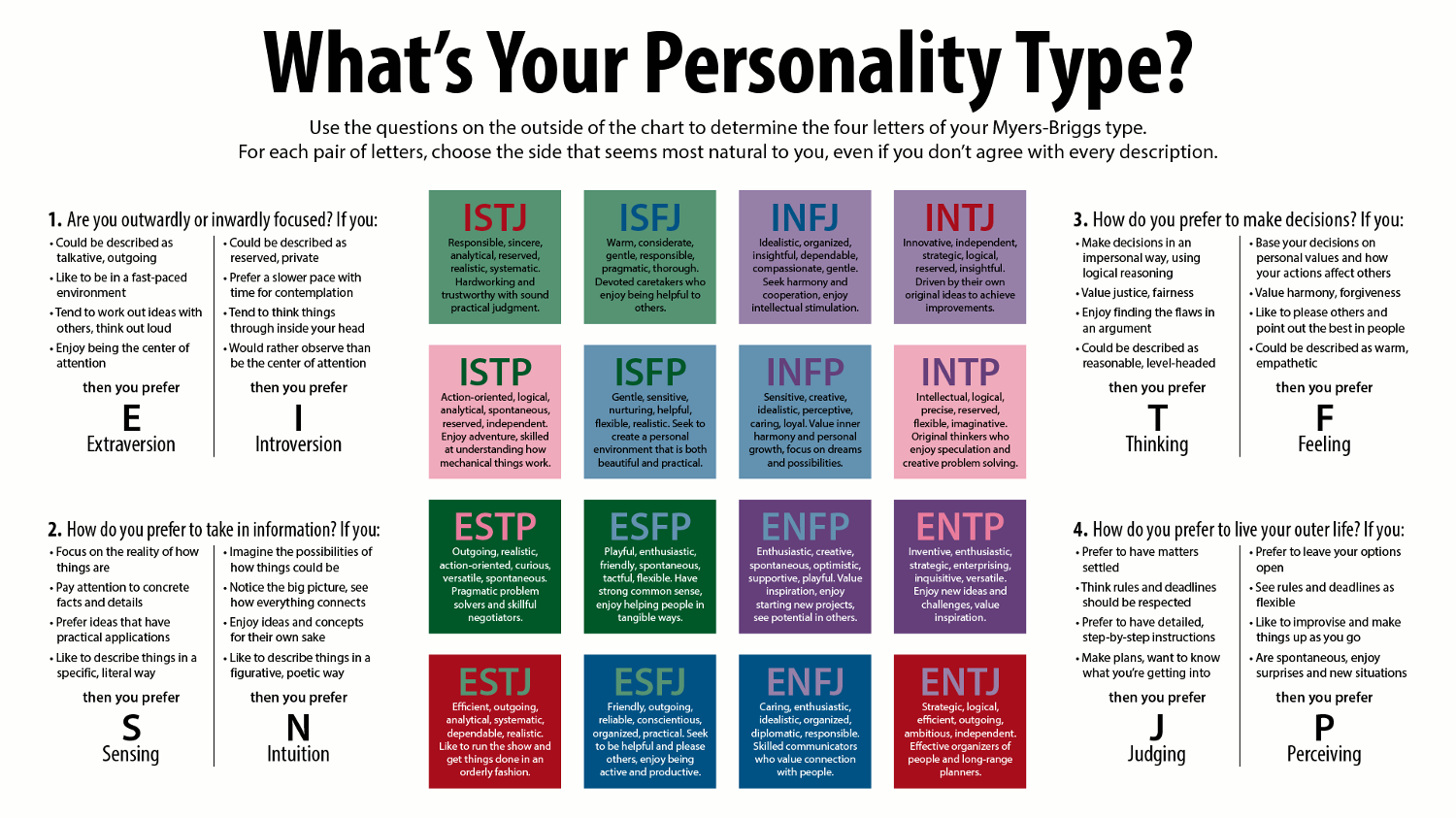 Myers-Briggs personality types. (Source)

2. Software engineers against the population
Capretz [1] compared software engineers’ MBTI types against a US population baseline. Read How solid is this? before quoting either row.
MBTI distribution in the general US population:
| Type | ISTJ | ISFJ | INFJ | INTJ |
|---|---|---|---|---|
| % | 11.6% | 13.8% | 1.5% | 2.1% |
| Type | ISTP | ISFP | INFP | INTP |
| % | 5.4% | 8.8% | 4.4% | 3.3% |
| Type | ESTP | ESFP | ENFP | ENTP |
| % | 4.3% | 8.5% | 8.1% | 3.2% |
| Type | ESTJ | ESFJ | ENFJ | ENTJ |
| % | 8.7% | 12.3% | 2.5% | 1.8% |
MBTI distribution among software engineers:
| Type | ISTJ | ISFJ | INFJ | INTJ |
|---|---|---|---|---|
| % | 24% | 2% | 1% | 7% |
| Type | ISTP | ISFP | INFP | INTP |
| % | 8% | 5% | 2% | 8% |
| Type | ESTP | ESFP | ENFP | ENTP |
| % | 8% | 1% | 3% | 7% |
| Type | ESTJ | ESFJ | ENFJ | ENTJ |
| % | 15% | 4% | 1% | 4% |
Four contrasts carry the comparison. ISTJ is about twice as common among software engineers (24% against 11.6%) and INTJ about three times as common (7% against 2.1%) — the detail-driven and strategy-driven variants of one preference set. In the other direction ISFJ is roughly seven times rarer (2% against 13.8%) and ESFP roughly eight times rarer (1% against 8.5%); both are the sociable, harmony-oriented types. This is self-selection into an occupation, not a description of any individual engineer.
3. Can you build a team from personality types?
This is the question managers want answered, and where the literature stops helping.
There is no evidence that personality composition predicts how a software team performs. Soomro and colleagues [2] searched 22 years of literature for this link and found no association. Advice to “mix personality types” or pair particular four-letter codes is folk practice, not a finding, however often it is taught as one. The same applies to type-based prescriptions for communication, task assignment and motivation: plausible, widely repeated, untested.
What does predict team performance is a different list:
- Psychological safety — whether people can admit mistakes and raise problems without penalty — predicts team behaviour and software quality with real effect sizes [3], and outranks every diversity variable tested [4]. See Trust and psychological safety.
- Stable membership matters more than co-location: occasional recomposition degrades a team’s behaviour considerably more than distance does [5].
- Autonomy is the work-design factor most reliably associated with psychological safety [6].
A manager can change all three; personality type is not one of them.
4. So what is MBTI good for here?
As a vocabulary for self-reflection and a prompt for conversations about working style — roughly how Capretz uses it. For example, an engineer who says in a retrospective “I need the design written down before the meeting rather than discovered during it” has started a useful conversation; routing that engineer to documentation because a table says ISTJ has not. As a selection or team-composition instrument MBTI is unsupported, and Capretz notes that no personality instrument reliably predicts success in the field.
How solid is this?
- The sample behind the tables. Capretz surveyed 100 people (80% men) with MBTI Form G — a convenience sample of students, government employees and company staff selected by occupation, with no sampling frame and no significance test reported. Respondents were Canadian; the baseline is the 1998 MBTI Manual US figures. Capretz notes the 81/19 thinking–feeling split may partly reflect the 80/20 gender split. Treat the contrast as suggestive, not as a measured population difference.
- No profile replicates. Cruz and colleagues [7] surveyed forty years of this literature and found no consistent software-engineering personality profile across the studies reporting one.
- Absence of evidence, not evidence of absence. Soomro retrieved 35 studies, of which only 12 addressed the personality–team-climate question at all and only 9 measured personality; none found an association. Too few asked, too inconsistently, to support a pooled estimate either way. What the review rules out is confident advice, in either direction.
Acknowledgments
This page adapts material from lectures by Eduardo Miranda and David Root [8] on software project management.
References
- L. F. Capretz,“Personality types in software engineering,” International Journal of Human-Computer Studies, vol. 58, no. 2, pp. 207–214, 2003.
- A. B. Soomro, N. Salleh, E. Mendes, J. Grundy, G. Burch, and A. Nordin,“The Effect of Software Engineers’ Personality Traits on Team Climate and Performance: A Systematic Literature Review,” Information and Software Technology, vol. 73, pp. 52–65, 2016, doi: 10.1016/j.infsof.2016.01.006.
- A. Alami, M. Zahedi, and O. Krancher,“The Role of Psychological Safety in Promoting Software Quality in Agile Teams,” Empirical Software Engineering, vol. 29, p. 119, 2024, doi: 10.1007/s10664-024-10512-1.
- C. Verwijs and D. Russo,“The Double-Edged Sword of Diversity: How Diversity, Conflict, and Psychological Safety Impact Software Teams,” IEEE Transactions on Software Engineering, vol. 50, no. 1, pp. 141–157, 2024, doi: 10.1109/TSE.2023.3339881.
- M. Hoffmann, D. Mendez, F. Fagerholm, and A. Luckhardt,“The Human Side of Software Engineering Teams: An Investigation of Contemporary Challenges,” 2021.
- M. P. Buvik and A. Tkalich,“Psychological Safety in Agile Software Development Teams: Work Design Antecedents and Performance Consequences,” in Proceedings of the 55th Hawaii International Conference on System Sciences, 2022.
- S. Cruz, F. Q. B. da Silva, and L. F. Capretz,“Forty Years of Research on Personality in Software Engineering: A Mapping Study,” Computers in Human Behavior, vol. 46, pp. 94–113, 2015, doi: 10.1016/j.chb.2014.12.008.
- D. Root,Managing Software Development. Carnegie Mellon University / Innopolis University lecture series, 2014.
Disclaimer: AI is used for text summarization, polishing and explaining. Authors have verified all facts and claims. In case of an error, feel free to file an issue.