Cultural dimensions Geert Hofstede

Based on: Hofstede, Geert. “Dimensionalizing cultures: The Hofstede model in context.” Online readings in psychology and culture 2.1 (2011): 8.

Hofstede’s method originated in the 1960s–70s as a large-scale cross-national survey of IBM employees. Using standardized questionnaires, Hofstede collected responses about workplace values and behaviors, then applied statistical techniques (factor analysis) to identify recurring cultural dimensions. Early work produced four dimensions (Power Distance, Individualism, Masculinity, Uncertainty Avoidance); later research added Long-term Orientation and Indulgence, yielding six commonly used indices. For each country Hofstede computed average scores on each dimension, normalized to a 0–100 scale, enabling cross-country comparisons.

The method’s practical steps are: design standardized survey items about values and practices; administer across many countries; aggregate responses at the national level; use factor analysis to extract dimensions; compute country scores and interpret patterns. Hofstede’s indices are descriptive heuristics—useful for anticipating cultural tendencies—but scholars warn about limitations: reliance on IBM’s employee sample, ecological fallacy (country averages ≠ individuals), historical staleness, and measurement choices. Despite critiques, Hofstede’s framework remains widely used in management and cross-cultural research as a parsimonious way to think about national-level cultural differences, provided users treat scores as provisional guides and combine them with local context and up-to-date data. In classroom and managerial use, pair Hofstede insights with qualitative local inquiry and iterative validation to avoid stereotyping or outdated assumptions.

Important caveat: national scores describe typical, aggregate tendencies of societies — they are statistical, not deterministic. There is wide individual variation within every country and organizational / occupational cultures can differ from national averages. Use these dimensions as heuristics to design management practices and anticipate friction, not as hard rules or stereotypes.


1. Quick summary of Hofstede’s six dimensions

  1. Power Distance (PDI) — extent to which less-powerful members of a society accept unequal power distribution. Low PDI → flatter interactions, expect to be consulted; high PDI → hierarchical, expect directives.

  2. Individualism vs Collectivism (IDV) — degree to which people are integrated into groups. High individualism → emphasis on personal goals, autonomy and directness; collectivism → emphasis on group harmony, relationships, group loyalty.

  3. Masculinity / Motivation toward achievement (MAS) — often framed as competition/achievement vs caring/quality-of-life. Higher scores indicate stronger emphasis on achievement, performance and success; lower scores emphasize cooperation, work–life balance and consensus. (Hofstede labels this Masculinity/Femininity; your dataset labels it “motivation towards achievement”.)

  4. Uncertainty Avoidance (UAI) — tolerance for ambiguity and unstructured situations. High UAI → preference for rules, plans, detailed specs and formal procedures; low UAI → tolerance for experimentation, “learn-as-you-go”, and informal processes.

  5. Long-term Orientation (LTO) — focus on future rewards (thrift, persistence) vs short-term oriented values (tradition, quick results). High LTO → planning, deferred payoff, sustained investment in architecture/tech debt; low LTO → emphasis on tradition, quick wins.

  6. Indulgence vs Restraint (IVR) — degree to which a society allows relatively free gratification of basic human drives related to enjoying life and having fun. High indulgence → emphasis on leisure, individual enjoyment, expressive behavior; restraint → stricter social norms, less overt emphasis on leisure.

(Each dimension and its managerial implications are discussed further below.)


2. How the dimensions differ conceptually

  • PDI vs IDV: Power Distance is about who makes decisions and how hierarchical interactions are. Individualism is about whether people prioritize individual or group goals. You can have low PDI + high individualism (flat + autonomous) or high PDI + high individualism (hierarchy but focused on individual achievement).

  • UAI vs LTO: Uncertainty Avoidance is about tolerance for ambiguity now (preference for rules, testing); Long-term Orientation is about time horizon (preference for investments that pay off later). A team can be low UAI (tolerant of quick prototypes) but high LTO (willing to invest in enduring architecture once the strategy is set).

  • MAS vs IVR: Masculinity/Achievement focuses on competitiveness and performance metrics; Indulgence focuses on QoL, leisure and emotional expression. They affect incentives and morale differently — performance pay & public recognition vs social perks and work–life policies.

Hofstede’s work also recommends treating these as complementary lenses: when designing practices consider several dimensions together (e.g., high UAI + high PDI will amplify preference for formal approvals and detailed plans).


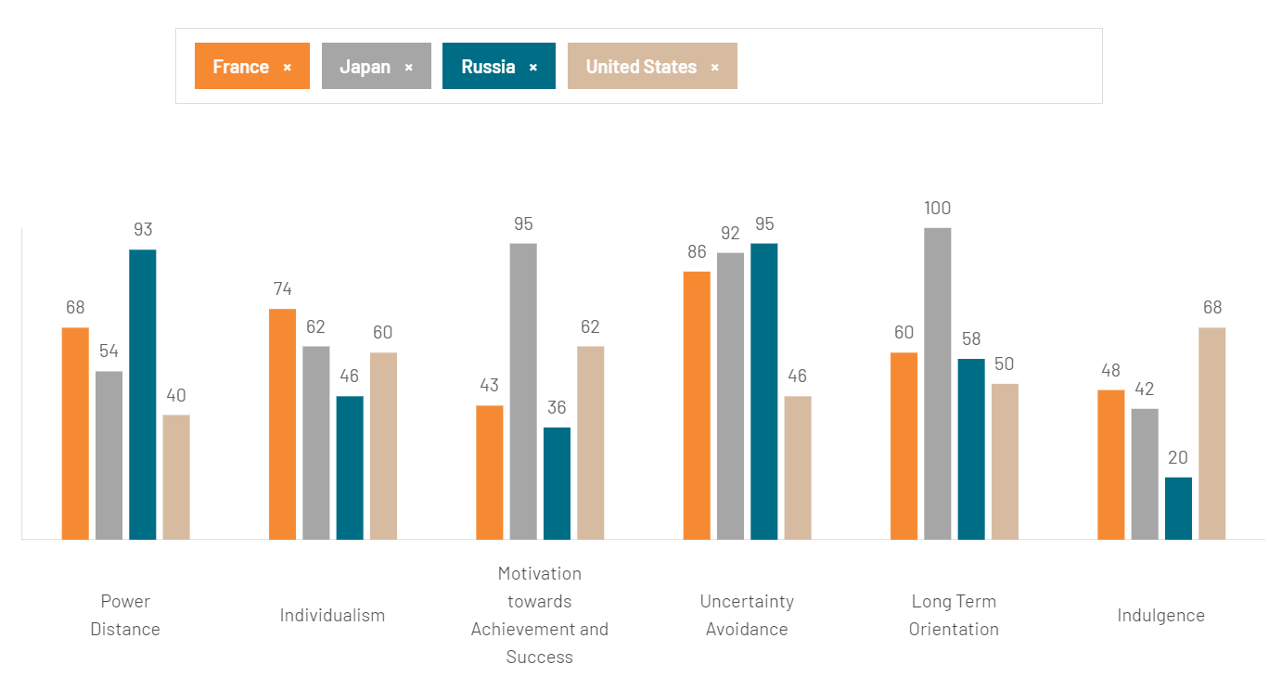
Hofstede US, France, etc

Fig. Country comparision by Hofstede link

3. US vs France — scores example

Dimension US score France score Possible interpretation
Power Distance (PDI) 40 68 US more egalitarian/flat; France more accepting of hierarchy and formal authority.
Individualism (IDV) 60 74 Both individualistic, France even more so in your numbers → expect emphasis on personal autonomy and line-of-sight to career outcomes.
Motivation/Achievement (MAS) 62 43 US stronger on achievement/competition; France more moderate, with more emphasis on consensus/quality-of-life.
Uncertainty Avoidance (UAI) 48 76 US more tolerant of ambiguity and experimentation; France prefers structure, rules, detailed specs.
Long-term orientation (LTO) 50 60 France slightly more future-oriented (willing to plan/standardize); US more balanced/shorter horizon here.
Indulgence (IVR) 68 48 US more indulgent (leisure, expressive), France more restrained in your data.

These scores are interpreted relatively — they describe tendencies that are useful to anticipate how teams prefer to work and interact.


4. Practical implications for managing software-engineering projects (by dimension)

Below are direct management implications and concrete examples you can use when running software projects that involve US and French engineers, or when designing team practices informed by these dimensions.

Power Distance (PDI)

Implications

  • High PDI (France ~68): people expect clearer authority and formal approval processes. Directives from senior engineers/managers are accepted; juniors may be less likely to openly contradict seniors in public forums.
  • Low PDI (US ~40): flatter communication, expectation of being consulted; open critique of senior proposals is normal.

Examples & practices

  • For a multinational architecture review → in France emphasize a formal agenda, decision authority and circulate documents in advance (managers endorse the session). In US teams favour open debate, asynchronous PR comments and live whiteboard sessions.
  • When soliciting feedback: in France prefer private 1:1 upward feedback channels or use moderated channels; in US use open Slack threads and inclusive design sessions.

Individualism (IDV)

Implications

  • Higher IDV (France 74, US 60 in your data): stronger emphasis on individual contribution, personal recognition, and career ladders.
  • Team incentives should include individual growth paths and clear personal attribution for work.

Examples & practices

  • Performance reviews: ensure clear individual objectives and recognized contributions (e.g., credit in release notes, promo criteria) — especially important where IDV is high.
  • Code ownership: adopt explicit ownership labels for modules so individuals (or tech leads) get clear credit and responsibility.

Motivation / Achievement (MAS)

Implications

  • High achievement orientation (US 62): people respond well to performance targets, public recognition, competitive hackathons and merit-based rewards.
  • Lower MAS (France 43): prefer consensus, intrinsic motivations, balanced recognition and may value peer evaluations and collective goals more.

Examples & practices

  • Running a productivity incentive: in US-heavy teams use public leaderboards, stretch goals, or bonuses tied to delivery (but beware gaming). In French teams emphasize peer recognition, constructive reviews and career progression conversations rather than public competitions.

Uncertainty Avoidance (UAI)

Implications

  • High UAI (France 76): prefer well-documented specs, test plans, risk registers, deterministic processes and fewer last-minute scope changes.
  • Low UAI (US 48): tolerate quick prototyping, experiments, minimal documentation early on.

Examples & practices

  • Agile ceremonies: for French teams add more structure to sprint planning: clearer acceptance criteria, explicit test plans and sign-offs. For US teams allow looser MVP definition and iterative discovery.
  • Incident management: high UAI cultures prefer structured runbooks and formal post-incident procedures; low UAI cultures accept trial-and-error fixes and fast rollbacks.

Long-term Orientation (LTO)

Implications

  • High LTO (France 60): more willingness to invest in long-term architecture, refactoring, technical debt repayment.
  • Lower LTO (US 50): preference for quicker business wins; more tolerance for taking tech-debt if it speeds time-to-market.

Examples & practices

  • When proposing a major refactor: frame it in ROI over 6–24 months to win US support; in France you will likely find more receptivity to systematic architecture roadmaps and standards.
  • Use LTO insight to balance sprint planning vs platform investments: formalize a cadence for “infrastructure sprints” that appeals to high-LTO teams.

Indulgence vs Restraint (IVR)

Implications

  • High indulgence (US 68): cultures more comfortable with flexible schedules, perks, expressive company culture, and emphasis on leisure/well-being.
  • Lower indulgence (France 48): stricter social norms, less emphasis on public celebration; might see formal rules around work hours & behavior.

Examples & practices

  • Work–life policies: in US teams flexible hours, remote-first, “fun” perks are strong retention levers; in French teams emphasize clear legal/contractual entitlements, predictable schedules and respect for time-off.
  • Morale & benefits: tailor recognition — celebrations and public shout-outs (US) vs formal awards and quality-of-life measures (France).

5. Cross-cutting recommendations — designing practices for mixed teams

When teams include both US and French members, combine the insights above into operational policies:

  1. Hybrid meetings & decision rules

    • Circulate materials ahead (satisfies high UAI, PDI) + run an open Q\&A period in the meeting (satisfies low PDI and US openness).
    • End with an explicit decision statement: who decides, by when, and how to appeal (satisfies expectations across PDI).
  2. Code review culture

    • Encourage open PR discussion (US-style) but require documented, respectful review comments and optionally escalate to module owners for final decisions (helps high UAI & PDI colleagues feel secure).
  3. Onboarding & documentation

    • Provide high-quality written docs, architecture decision records (ADR) and a roadmap (helps high UAI and LTO members), but also add short “how to get started” videos and live pairing sessions for US-style quick integration.
  4. Goal setting & incentives

    • Combine individual goals and team OKRs: public recognition & bonus elements for high MAS contributors (US), and stable career development pathways and peer-reviewed competence growth for French colleagues.
  5. Incident & change management

    • Maintain formal runbooks, approvals and postmortems (France-friendly) but include “emergency fast path” rules for rapid fixes (US-friendly) — and document when each path is used.
  6. Culture of feedback

    • Because high PDI members may avoid public dissent, provide anonymous feedback channels and scheduled 1:1s with senior management; also cultivate an open culture for critique with clear norms to protect face and respect.

6. Short worked examples (concrete scenarios)

Example A — Architecture decision that affects multiple squads

  • Context: CTO proposes a migration to a new message-bus technology.
  • US team reaction (you data): expect open debate, prototypes, and rapid A/B testing in prod can be acceptable.
  • France team reaction: expect formal evaluation, risk analysis, security review, and manager approval before broad rollout.
  • Manager action: publish a decision memo (satisfies UAI + PDI), run a cross-squad prototyping spike (satisfies US appetite for experiment), and schedule a governance review with named approvers and timeline (satisfies France preferences).

Example B — Sprint planning & scope changes

  • Context: Product requests mid-sprint scope changes to chase a market window.
  • US approach: tolerate scope pivot, push for fast delivery (lower UAI, indulgence).
  • France approach: request impact assessment and formal schedule change (higher UAI, PDI).
  • Manager action: adopt a two-lane approach — allow a limited “fast lane” for urgent items with strict rollback & testing rules, and require formal change requests for anything affecting cross-team APIs.

Example C — Retaining senior engineers

  • Context: High performers considering offer.
  • US levers: performance bonuses, stock/options, public recognition, and flexible perks.
  • France levers: secure career path, formal role upgrade process, predictable workload and legal protections (work hours, benefits).
  • Manager action: craft retention package with both a clear promotion plan + fast decision on compensation and explicit non-work benefits that respect local preferences.

7. Practical checklist for project managers (actionable)

  • Before kickoff, map key stakeholders to likely dimension expectations (PDI, UAI, LTO) and state decision rights explicitly.
  • Always circulate agendas + docs before important meetings (helps high UAI / PDI participants).
  • Combine team-level OKRs with individual performance markers (balances IDV and MAS).
  • Use ADR (Architecture Decision Records) and runbooks to satisfy high UAI and LTO concerns.
  • For cross-cultural feedback, use a mix of public channels and private 1:1s / anonymous surveys.
  • Timebox experimental work with clear acceptance criteria so both low-UAI experimenters and high-UAI planners see safeguards.
  • Normalize a blended recognition scheme: public shoutouts + formal written testimonials / career credits.

Disclaimer: AI is used for text polishing and explaining. Authors have verified all facts and claims. In case of an error, feel free to file an issue.