Lifecycles
A software lifecycle is the cradle-to-grave existence of a product — initial development, repairs and enhancements, and eventual decommissioning. A lifecycle model generalises that into phases with associated activities and artefacts, so that a team can say where it is and what comes next.
That is most of the value: a shared model lets the team discuss progress, lets management see status, and tells a customer what happens next.
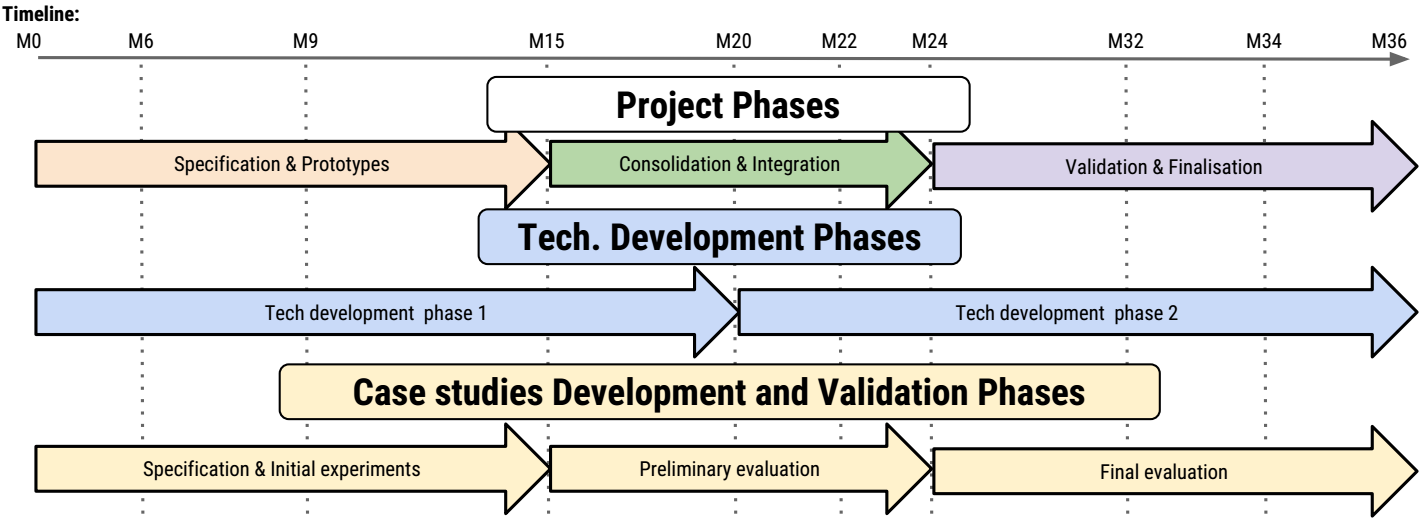
A lifecycle model from a research project. © Sadovykh, Truscan, Bruneliere.
1. Process, lifecycle model, framework
These three words are used loosely and are examined precisely, so it is worth putting them on one ladder from most abstract to most concrete:

- Lifecycle model — the phases a product passes through and the go/no-go points between them. Waterfall, spiral, incremental.
- Framework — a reusable structure of roles, events and practices that a team adopts. Scrum describes itself as “a container for other techniques, methodologies, and practices” [1], which is exactly what a framework is and exactly what a lifecycle model is not.
- Process — what one organisation actually does, in detail: the specific steps, at the level ETVX describes them.
Process definitions carry more detail than lifecycle models, and a process is often defined within a lifecycle model. SWEBOK’s caution belongs here too: “There is no best software process… No ideal process, or set of processes, exists” [2].
2. Which model, and what it optimises
| Model | Structure | Feedback | Choose it when |
|---|---|---|---|
| Waterfall | Linear, once through | Late | Requirements are stable and the work must be contractible and audited |
| V-Model | Waterfall, drawn to show V&V | Late, but tests designed early | Verification must be demonstrated to a regulator or customer |
| Incremental | Usable slices, staged | Per increment | You know what to build but cannot build it all at once |
| Iterative | Whole product, repeated | Every iteration | You do not yet know exactly what to build |
| Prototyping and RAD | Build to answer a question | Immediate | A specific uncertainty is cheaper to resolve by building than by analysis |
| Spiral | Risk-driven loops | Every cycle | Risk should decide what happens next, and you control the commitment points |
This is a map, not a menu. In practice teams combine them — incremental delivery developed iteratively, with prototypes for the risky parts — and the spiral is best read as a rule for choosing among the others one cycle at a time.
How solid is this?
These models are well-established vocabulary, and that is the right claim for them. No source in this review compares lifecycle models on measured outcomes, so the “choose it when” column is reasoned from what each model does, not from evidence that it wins. Each page states its own sourcing; the weakest are prototyping and RAD, taught here as practice with no primary study behind them. The ladder in §1 is a convention drawn from SWEBOK, Pressman and the Scrum Guide — citable, but a convention rather than a finding, and other authors draw the lines differently.
Acknowledgments
These pages adapt material from lectures by Eduardo Miranda and David Root [3] on software project management.
References
- K. Schwaber and J. Sutherland,“The Scrum Guide.” Nov. 2020. [Online]. Available: https://scrumguides.org/docs/scrumguide/v2020/2020-Scrum-Guide-US.pdf
- P. Bourque and R. E. Fairley, Eds.,“SWEBOK: guide to the software engineering body of knowledge.” IEEE Computer Society, 2014.
- D. Root,Managing Software Development. Carnegie Mellon University / Innopolis University lecture series, 2014.
Disclaimer: AI is used for text summarization, polishing and explaining. Authors have verified all facts and claims. In case of an error, feel free to file an issue.