Expectation Space and Solution Space
The expectation space is the set of things a customer can actually control and therefore trade — scope, time, quality and cost. The solution space is the developer’s equivalent: people, process and technology. Negotiation happens between the two, and each side can only offer what it holds [1].
This pairing is widely taught as “Hoover’s quadrant”, which is the name to recognise in a question paper. The book’s own term is the expectation space, and its fourth customer-side element is cost — you will also meet it as budget or resources.
 An expectation is a point, not a list; f(x) is the manager’s job. [1]
1. Each side can only trade what it controls
| Customer controls | Developer controls |
|---|---|
| Scope — what gets delivered | People — who is on the team, and their skills |
| Time — when it is needed | Process — how the work is organised and checked |
| Quality — how good it must be | Technology — languages, platforms, architecture |
| Cost — what it may cost |
The manager’s job is translation. A developer-side decision only becomes negotiable once it is restated in the customer’s four terms: choosing an unfamiliar framework (technology) is a time and cost claim; adding a code review stage (process) is a quality claim paid for in time.
Hoover’s framing matters more than the grid. The object of negotiation is to enlarge the space — “the negotiation process stimulates stakeholders to explore options that optimize the expectation space for all” — not to divide a fixed budget across four corners.
2. The reason the two sides cannot negotiate unaided
Boehm names the underlying problem the Two Cultures: neither side has a feel for what is cheap or expensive on the other’s side [2]. The consequence is specific — “if the customers have no idea of the relative cost and difficulty of a requirement, they are more likely to enter infeasible requirements as statements of need.”
The blindness runs both ways. Boehm’s developer-side example is the misapplied Golden Rule: build a friendly interface as you would want one, and you have built a programmer-friendly interface.
3. What happens when cost becomes visible
For example, a Windows beta customer in 1992 brought two change requests to the team, both labelled must have [3]. One was a toolbar button: half a day. The other was hot-linked drag-and-drop page import, requiring full OLE support: six to nine staff months. Once the customer knew the two costs, their own response to the expensive one was “No way! It’s not that important.”
Nobody negotiated and nobody refused. The information did the work, and the customer got their toolbar button and the release date — an outcome no division of a fixed pie produces. That is what “educate the customer” means in practice: make the cost structure legible, with a task breakdown, an impact statement or a prototype, rather than explaining that software is hard.
 What they price is what they can see.
4. Where this stops working
The model assumes both sides have authority to trade. A customer representative who cannot move scope, and a team that cannot change its own process or staffing, have no space between them to enlarge — the negotiation is theatre, and the real decision sits with people who are not in the room. Identify them before the meeting rather than after it; see stakeholders.
The four dimensions also shift in prominence as a project runs: scope dominates the early conversation, cost and schedule the middle, and quality the end, when the question becomes whether the delivered thing actually works.
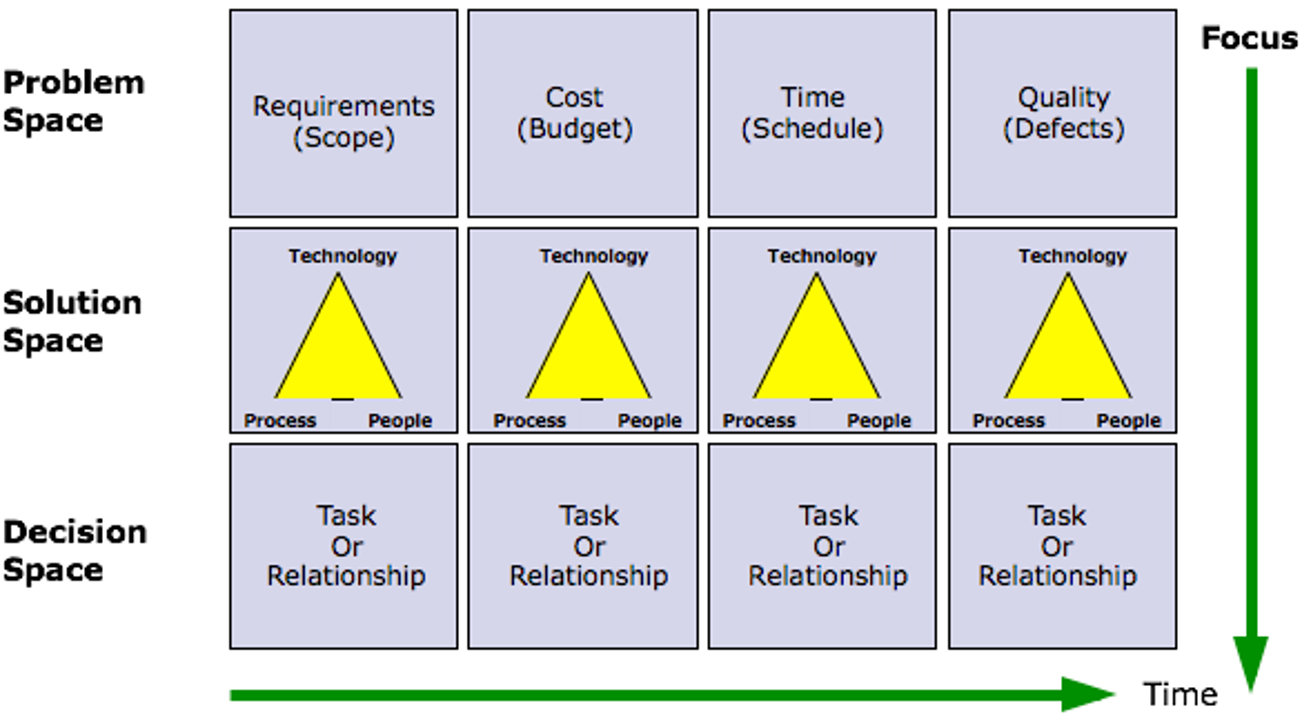 Problem, solution and decision spaces over the life of a project. [1]
How solid is this?
- Where it comes from. Hoover, Rosso-Llopart and Taran is a software textbook built on case studies, read here for chapters 2, 7 and 9. It establishes definitions and method; nothing in it measures whether negotiating this way improves outcomes.
- What is contested. Nothing substantive — but the naming is unstable. Quadrant is not the book’s word, and budget and resources both circulate for what Hoover calls cost.
- What we do not hold. McConnell’s 1992 anecdote is a practitioner account, not a study.
Acknowledgments
This page adapts material from lectures by Eduardo Miranda and David Root [4] on software project management.
References
- C. L. Hoover, M. Rosso-Llopart, and G. Taran,Evaluating Project Decisions: Case Studies in Software Engineering. Addison-Wesley Professional, 2010. [Online]. Available: https://www.oreilly.com/library/view/evaluating-project-decisions/9780321685629/
- B. Boehm, M. Abi-Antoun, D. Port, J. Kwan, and A. Lynch,“Requirements engineering, expectations management, and the Two Cultures,” in Proceedings IEEE International Symposium on Requirements Engineering (Cat. No.PR00188), June 1999, pp. 14–22. doi: 10.1109/ISRE.1999.777981.
- S. McConnell,Rapid development: taming wild software schedules. Pearson Education, 1996.
- D. Root,Managing Software Development. Carnegie Mellon University / Innopolis University lecture series, 2014.
Disclaimer: AI is used for text summarization, polishing and explaining. Authors have verified all facts and claims. In case of an error, feel free to file an issue.