Capturing, Owning and Mitigating Risks
A risk statement records a condition that is true today and the concern that follows. The standard form is one line [1]: “Given that condition then there is concern that (possibly) consequence.”
1. Start from something you can check today
Students write risks as predictions: “the vendor might be late.” The repair is to write the present-tense fact first. For example, on one programme the recorded conditions were 25% of the code written against 50% of the schedule consumed, five workstations for a team of ten, and the vendor’s compiler two weeks late [1]. Each is observable, so nobody has to be persuaded of the concern.
2. Three formats, one content
If–then, condition–consequence and because–event–consequence carry the same three elements: the event or condition, the consequence, and the cause where known. Pick one and use it consistently — a register is readable across teams because the shape is the same [2].
Consequences carry a number and a unit. “Supplier quality problems may cause program delays” is not a consequence; “a 30-day delay to the start of testing” is [3]. Refinement sharpens the condition while holding the consequence fixed [4].
A well-formed statement can still be a bad one when it points away from what the team controls: “if funding is withheld due to poor test results…” has the test results as its real subject [2].
3. A worked case: Comair, December 2004
Comair’s crew-scheduling system was eleven years old, written in Fortran nobody at the airline was fluent in, and the last application on an obsolete platform. It had a fixed ceiling of 32,000 trip transactions per month. Severe weather forced more than 6,000 crew changes between 22 and 24 December 2004; the system hit the limit and shut down just after 10 p.m. on Christmas Eve. The airline cancelled or delayed 89% of its scheduled holiday-period departures, affecting about 191,000 passengers by cancellation and 78,000 by delay [5], at a cost to Comair and Delta of about $20 million [6].
 Not the storm. A hard-coded limit. [5]
Every element of a register was present years in advance. A replacement was proposed in 1997, rejected on good grounds, deferred four times for defensible reasons — Y2K, an acquisition, a pilots’ strike, a downturn — approved in 2004, and still in testing when the failure beat it by months. It “could have been avoided if Comair or Delta had done a comprehensive analysis of the risk that this critical system posed.”
4. The register row, and the four responses
A register row carries the statement; the probability, impact and exposure; one named owner; the response; a trigger and contingency; and the status with its last change [7]. For example: given that the 2-second target has only been tested with 100-page documents, 500-page documents may fail acceptance, delaying release by three weeks · 0.4 · 3 weeks · 1.2 weeks · owner: the tech lead · response: reduce, build a 500-page test set this sprint · trigger: more than 2 seconds on 1 November → switch to lazy page loading · open. A row without an owner is a worry; a row without a trigger is a plan that never starts.
The response is one of four [8]: avoid (change the plan so the risk cannot happen), reduce (lower the probability or the impact now), transfer (make another party carry it, by contract or insurance) or accept (live with it and watch). Whichever is chosen, respond only if it costs less than the exposure it removes.
5. Owning and tracking
Planning a response means choosing the action, the observables, the thresholds that say performance is still acceptable, the protocol on exceedance, and the owner. A mitigation with no threshold cannot trigger.
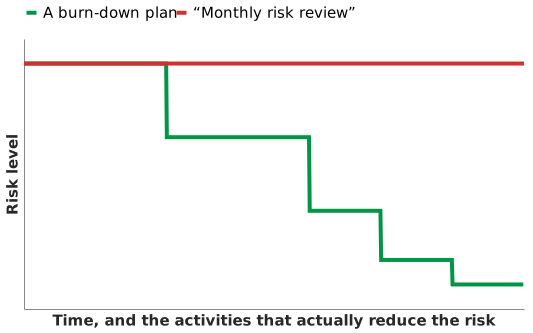 Mitigations burn risks down. Meetings do not. [8]
The cheapest continuous practice is a top-10 list, and its value is one column: last week’s rank [9]. Review it weekly with the boss present, and keep the risks that dropped off on it [10].
Mitigation needs to be a plan rather than a meeting: “risk burn-down plans should be time-phased and include specific measurable mitigation activities; meetings do not burn down risks” [8]. And expect total exposure to rise before it falls: on one twelve-month project it went from 43 days of expected delay to 46.5, then down to 3 [11]. A flat or rising line late is the warning.
How solid is this?
- Where it comes from. Two SEI reports, two government guides, a textbook and a conference paper. None measures whether any of this improves outcomes.
- What is contested. No source shows that condition–consequence registers outperform free text.
- What we do not hold. The Comair figures are the federal audit’s; the decision history is trade journalism.
Acknowledgments
This page adapts material from lectures by Eduardo Miranda and David Root [12] on software project management.
References
- D. P. Gluch,“A Construct for Describing Software Development Risks,” Software Engineering Institute, Carnegie Mellon University, Technical Report CMU/SEI-94-TR-14, July 1994.
- J. Thompson and S. Stump,“How to Write a Good Risk Statement,” Defense AT&L, Nov. 2017, [Online]. Available: https://www.dau.edu/library/damag/november-december2017/how-write-good-risk-statement
- R. C. Williams, G. J. Pandelios, and S. G. Behrens,“Software Risk Evaluation (SRE) Method Description, Version 2.0,” Software Engineering Institute, Carnegie Mellon University, Technical Report CMU/SEI-99-TR-029, Dec. 1999.
- R. S. Pressman,Software Engineering: A Practitioner’s Approach, 7th ed. McGraw-Hill, 2010.
- U.S. Department of Transportation, Office of Inspector General,“Air Carrier Flight Delays and Cancellations,” U.S. Department of Transportation, SC-2005-051, July 2005.
- S. Overby,“Comair’s Christmas Disaster: Bound to Fail,” CIO Magazine, May 2005.
- NASA,“NASA Systems Engineering Handbook,” National Aeronautics and Space Administration, NASA Special Publication SP-2007-6105 Rev1, Dec. 2007. [Online]. Available: https://www.nasa.gov/reference/systems-engineering-handbook/
- Office of the Under Secretary of Defense for Research and Engineering,“Risk, Issue, and Opportunity (RIO) Management Guide for Defense Acquisition Programs,” U.S. Department of Defense, Sept. 2023.
- B. W. Boehm,“Software Risk Management: Principles and Practices,” IEEE Software, vol. 8, no. 1, pp. 32–41, Jan. 1991, doi: 10.1109/52.62930.
- S. McConnell,Rapid development: taming wild software schedules. Pearson Education, 1996.
- N. K. Shrivastava,“Project Risk Management: Another Success-Boosting Tool in a Project Manager’s Toolkit,” in PMI Global Congress 2012 — North America, Project Management Institute, 2012.
- D. Root,Managing Software Development. Carnegie Mellon University / Innopolis University lecture series, 2014.
Disclaimer: AI is used for text summarization, polishing and explaining. Authors have verified all facts and claims. In case of an error, feel free to file an issue.