Risk Analysis and Prioritisation
Risk exposure is probability times loss: RE = P(UO) × L(UO), “where RE is the risk exposure, P(UO) is the probability of an unsatisfactory outcome and L(UO) is the loss to the parties affected if the outcome is unsatisfactory” [1]. Pressman writes it RE = P × C, where C is the cost to the project — a monetary quantity, which is what makes exposures summable and comparable to a budget [2].
Analysis exists to answer one question: which few risks do you act on?
1. What the number is actually for
For example, a satellite experiment has $20 million at stake and a team inexperienced in software development. Three options [1]:
| Option | Probability of an unsatisfactory outcome | Exposure |
|---|---|---|
| Do nothing | 0.4 | $8M |
| Help the team adopt better methods, at no extra cost | 0.1 | $2M |
| Buy independent verification and validation for $500,000 | 0.04 | $1.3M including the $500,000 |
Paying half a million is the cheapest option, because the comparison is not cost — it is cost plus residual exposure. That is what exposure is for: comparing options, not measuring the world.
 The $500,000 option was cheaper. [1]
It also answers the objection students raise immediately — “you made those probabilities up.” Re-run the comparison at its break-even points: the recommendation flips if the loss falls below $13M, if the team reaches 0.065 on its own, or if the review costs more than $1.2M. The question is not are the numbers right but how far wrong would they have to be to change the decision.
2. Bands need thresholds
A scale without defined bands is a vocabulary, not an instrument. The course teaches probability high above 70% and impact high at a schedule slip over 20% [3]; the government version ties severity to numbers — catastrophic is over 6 months’ slip, over 10% cost, over 10% functionality, with critical, serious, minor and negligible below [4].
The SEI’s evaluation method bands impact against budget instead: roughly more than 50%, about 30%, about 10% [5]. Use either, but write the numbers down — an undefined band is a word two people will use differently.
In that government table, Medium and High prescribe the same action. A five-level scale that acts on three levels is worth knowing about before you spend an hour arguing which one something is.
3. The vital few
Prioritising means “partitioning risks or groups of risks based on the Pareto ‘vital few’ sense [Juran 89]” — separating the vital few from the useful many [6]. In software terms: “80 percent of the overall project risk… can be accounted for by only 20 percent of the identified risks” [2].
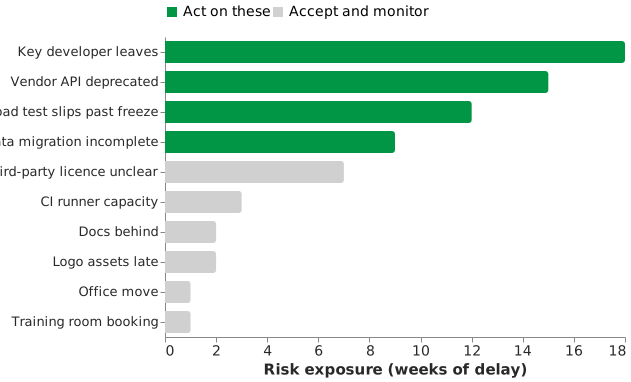 The vital few. [7]
The consequence is the part students resist: some identified risks never enter the mitigation plan. Identification is cheap and capacity is not, so selection is the skill.
The mechanic is small — compute exposure, sort, draw a cutoff line, act above it. Two asymmetries around that line matter. A catastrophic but very improbable risk should not absorb significant management time, while both high-impact/moderate-probability and low-impact/high-probability items carry forward. And cost-benefit the response: “if RE for a specific risk is less than the cost of risk mitigation, don’t try to mitigate the risk but continue to monitor it.”
 Where a risk sits picks the response, not its rank. [3]
McConnell adds three cases where the sorted list is only roughly ordered [7]: a catastrophic low-probability risk outranks its position if the loss would end the project; synergistic risks compound beyond the sum of their rows; and “because the input is subjective, the prioritization is subjective too.”
4. What the scoring scheme hides
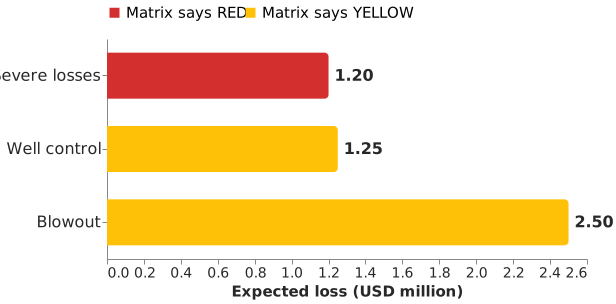 Same cell, orders of magnitude apart. [8]
Multiplying two ordinal scores is not exposure. A red-amber-green matrix is a communication device, and NASA says so about its own: “the risk matrix is not an assessment tool, but can facilitate risk discussions” [9]. A typical matrix compares fewer than 10% of hazard pairs correctly and unambiguously, and where frequency and severity are negatively correlated — the software case — it can be “worse than useless” [8].
The repair is not to abandon scoring but to rank by expected loss, carry the range, and keep the matrix for the conversation. Why the ranking goes wrong is on why we misjudge risk.
How solid is this?
- Where it comes from. A tutorial article whose worked case is a constructed scenario, a textbook, two government guidance documents and a method description. None reports a study.
- What is contested. The 80/20 split is a heuristic relayed from Juran, not a measured property of software risk; Pressman states it as “experience indicates”.
- What we do not hold. No source here validates any scale’s thresholds — the government bands are sourced, not tested.
Acknowledgments
This page adapts material from lectures by Eduardo Miranda and David Root [3] on software project management.
References
- B. W. Boehm,“Software Risk Management: Principles and Practices,” IEEE Software, vol. 8, no. 1, pp. 32–41, Jan. 1991, doi: 10.1109/52.62930.
- R. S. Pressman,Software Engineering: A Practitioner’s Approach, 7th ed. McGraw-Hill, 2010.
- D. Root,Managing Software Development. Carnegie Mellon University / Innopolis University lecture series, 2014.
- U.S. Department of Energy,“Software Risk Management A Practical Guide,” U.S. Department of Energy, Technical Standard SQAS21.01.00, 2000. [Online]. Available: https://energy.gov/sites/prod/files/cioprod/documents/Risk_Management.pdf
- R. C. Williams, G. J. Pandelios, and S. G. Behrens,“Software Risk Evaluation (SRE) Method Description, Version 2.0,” Software Engineering Institute, Carnegie Mellon University, Technical Report CMU/SEI-99-TR-029, Dec. 1999.
- A. J. Dorofee, J. A. Walker, C. J. Alberts, R. P. Higuera, R. L. Murphy, and R. C. Williams,Continuous Risk Management Guidebook, no. CMU/SEI-96-HB-002. Software Engineering Institute, Carnegie Mellon University, 1996.
- S. McConnell,Rapid development: taming wild software schedules. Pearson Education, 1996.
- L. A. Cox,“What’s Wrong with Risk Matrices?,” Risk Analysis, vol. 28, no. 2, pp. 497–512, Apr. 2008, doi: 10.1111/j.1539-6924.2008.01030.x.
- NASA,“NASA Systems Engineering Handbook,” National Aeronautics and Space Administration, NASA Special Publication SP-2007-6105 Rev1, Dec. 2007. [Online]. Available: https://www.nasa.gov/reference/systems-engineering-handbook/
Disclaimer: AI is used for text summarization, polishing and explaining. Authors have verified all facts and claims. In case of an error, feel free to file an issue.