Customer Involvement
Involving users is a lever with a cost and a setting, not a virtue. The largest synthesis available — 87 empirical studies over 32 years — reaches a two-sided conclusion [1]: “Our results have revealed that UI does contribute positively to system success. But it is a double edged sword and if not managed carefully it may cause more problems than benefits.”
1. What the evidence actually says
The review screened 2,776 citations down to 87 studies and classifies their results, in its abstract, as 52 positive, 12 negative, 23 uncertain. Badly run involvement produces unrealistic expectations, communication breakdown and intergroup hostility.
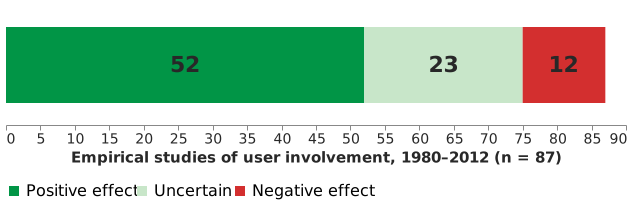 87 studies over 32 years. [1]
That turns an exhortation into four design decisions the review names:
- Which users? Primary (hands-on), secondary (occasional or via an intermediary), tertiary (affected but never touching it). A project that involved only primaries has not involved its users.
- At what degree? A ladder, not a switch: informative → consultative → participative, where participative means “users influence decisions relating to the whole system”. Promising participative while running informative is how involvement generates the negative results in the sample.
- For which goal? For satisfaction, structure participation to create a sense of control; for system quality, to move domain knowledge to the developers. These are different designs, and conflating them is how involvement disappoints.
- In which phase? Early buys accurate requirements and less resistance; design and implementation buy ownership; testing buys usability.
The review also states a genuine when-not: for routine transaction-processing systems with lower-level users, an analyst gathering requirements by interview is sufficient, and more involvement does not raise satisfaction.
2. Involvement is not participation
Participation is a set of behaviours — attending meetings, reviewing screens. Involvement is a psychological state: how important and personally relevant the system is to that user. A user can attend every session and not be involved, so “we involved the users” is not a checkable claim, and a project reporting attendance as involvement has measured the wrong thing.
3. When the customer will not give you the time
Agile methods assume an on-site customer. A three-year study of 30 practitioners in 16 organisations found teams routinely working without one, and mapped what they do instead as a continuum ordered by directness [2]:
On-site Customer → Story Owner → Just Demos → E-collaboration → Customer Proxy → Extreme Undercover.
 Fig. 5 — a continuum, not a ladder: the levels may occur simultaneously. [2]
Knowing which rung a project is on is more useful than any advice about collaboration. Two repairs from the study are concrete enough to copy: a Definition of Ready, so unclarified stories are demoted rather than guessed at, and a buffer sized from recorded velocity. For example, one team reserved two days of a two-week sprint and ran the customer hour as 15 minutes showing software and 45 minutes discussing it.
Customers defaulted to hands-off; those who had read the Scrum books expected unlimited scope freedom while resisting the involvement that pays for it.
 Fig. 4 — causes, condition, consequences, and the strategies that answer them. [2]
Extreme Undercover is a transition aid, not a permanent substitute. The authors are explicit, and it became less frequent across the three years as customers grew familiar with agile. Teaching it without that boundary would be teaching deception.
4. Customers can do real work — if you train them
Involvement can extend into the customer doing part of the job: self-service, defect reports, forum answers, reviews. Intuit adds “more than a hundred changes” to each annual release from customer-service input [3].
Two cautions. Untrained customers become antagonists — a loyal base is the hardest to retrain, which is why Southwest built a “Boarding School” before changing boarding. And a channel that collects then ignores is worse than none: it spends the credibility it runs on.
How solid is this?
- Where it comes from. A systematic review following EBSE guidelines (87 studies, 1980–2012), a grounded-theory study of 30 practitioners, and one chapter of a trade book whose numbers are business cases rather than research findings.
- What is contested. The review reports its own split two ways — the abstract gives 52/12/23, section 7 gives 59 positive, 7 negative, 21 uncertain. Both are verbatim and both total 87. The abstract’s figures are used above.
- What we do not hold. Nothing establishes that involvement causes success rather than that successful projects attract it, and 46 of the 87 studies are surveys — so the positive finding is substantially about what people report.
Acknowledgments
This page adapts material from lectures by Eduardo Miranda and David Root [4] on software project management.
References
- M. Bano and D. Zowghi,“A Systematic Review on the Relationship Between User Involvement and System Success,” Information and Software Technology, vol. 58, pp. 148–169, Feb. 2015, doi: 10.1016/j.infsof.2014.06.011.
- R. Hoda, J. Noble, and S. Marshall,“The Impact of Inadequate Customer Collaboration on Self-Organizing Agile Teams,” Information and Software Technology, vol. 53, no. 5, pp. 521–534, May 2011, doi: 10.1016/j.infsof.2010.10.009.
- J. L. Heskett, W. E. Sasser, and J. Wheeler,Ownership Quotient: Putting the Service Profit Chain to Work for Unbeatable Competitive Advantage. Harvard Business Press, 2008. [Online]. Available: https://www.hbs.edu/faculty/Pages/item.aspx?num=34971
- D. Root,Managing Software Development. Carnegie Mellon University / Innopolis University lecture series, 2014.
Disclaimer: AI is used for text summarization, polishing and explaining. Authors have verified all facts and claims. In case of an error, feel free to file an issue.