Critical chain
Critical chain project management (CCPM) schedules a project on its critical chain, the tasks that fix the project’s duration once both precedence and shared resources are counted, and protects the date with pooled buffers instead of safety hidden in each task [1]. Eliyahu Goldratt proposed it in Critical Chain (1997), a business novel [2].
1. Where the safety goes
In Rand’s summary, “Goldratt argues that the main reason for project overrun is because of the misuse of the safety time created within the estimated times for each activity.” [2]. The padding is not the cause; it is wasted, in three ways:
- work starts late because the safety is known to be there, which Goldratt calls the student syndrome, “leaving everything to the last minute”;
- a task finished early is not reported, since that invites a shorter estimate next time;
- multitasking pulls people off a task once it has started.
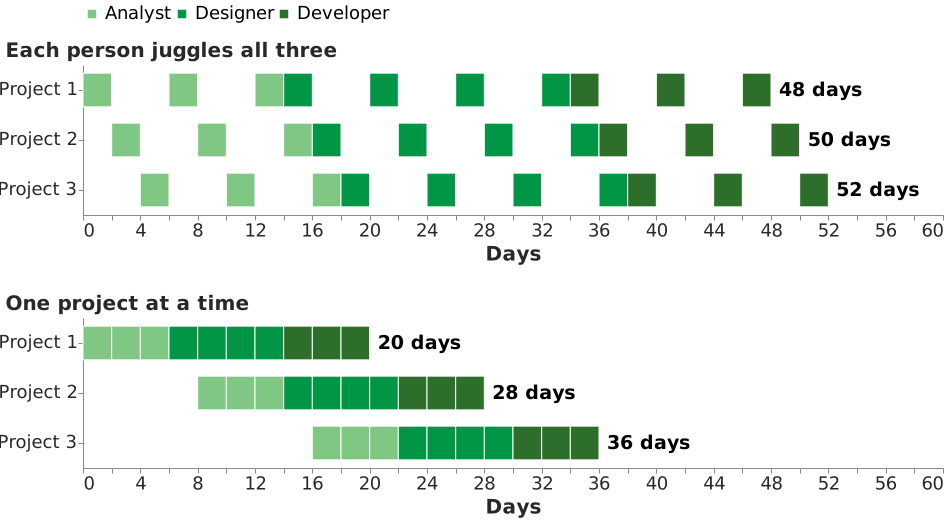
Zultner 2003, Figs. 9–10.
The second is usually credited to Parkinson: “It is a commonplace observation that work expands so as to fill the time available for its completion.” [3]. The behaviour has been measured under neither name: students given one week for a one-hour task finished it after 4.3 days on average, and those given two weeks after 9.1 [4].
2. Pool the safety, then find the chain
For example, Zultner takes three 10-day tasks, each five days of work and five of safety: 30 days. Pool the safety, as insurers pool risk, and one 8.66-day buffer gives the same 90% protection: about 24 days. Half the tasks will then overrun: “The only way you will get accurate 50% likely expected task times is if it is OK to exceed them.” [5]
The chain is the longest path once tasks sharing a person are sequenced, a “leveled critical path” [6]; see Critical path and Resource planning.
3. Buffers and relay runners
The pooled safety goes into a project buffer at the end of the chain; feeding buffers where other paths join it, so chain tasks never wait; and resource buffers, which are advance warnings rather than time [2] [1]. Feeding buffers answer merge bias, where a merge point “passes on the longest delay” [7]; see PERT and merge bias.
People on the chain work like relay runners: start the moment the predecessor finishes, work flat out, hand off at once, and give the next runner a countdown [5]. Nobody is criticised for one late task. The manager watches the buffer instead, in thirds: while the first third is used, do nothing; in the middle third, plan a response; in the last third, act [7]. Abbott Diagnostics, Brandt reports, reviewed its buffers weekly [5].
4. Example: one developer moves the date
Quill is a fictional word processor. Before its 2-day release build come Ana’s PDF export (10 days) and Dana’s citation-engine fix (6) and citation styles (7). The critical path runs through PDF export, 12 days, so everyone watches Ana. But Dana cannot do both her tasks at once; in sequence they make the longest path, 15 days. The chain is Dana’s, and PDF export becomes a feeding path.

So the manager watches Dana’s queue, not Ana’s progress.
Gelbwaks describes Segway running critical chain over agile iterations: agile decided what each iteration held, while a chain of stories decided when hardware, software and mechanics came together [5].
5. When to use it, and what to keep
Raz and colleagues would adopt the whole package only where planning is weak, many similar projects share people, and deadlines dominate; not in mature organisations or one-off work [6]. Elsewhere, keep the buffers and drop the rules sold with them. Size buffers from the chain’s risk, not as half its length. Re-identify the chain when delays change the schedule; it moves [1]. Treat “cut every estimate by half” as a guess about your own people, not a law.
How solid is this?
- The premises. Goldratt argues from a novel. The student syndrome has no study behind it, and Parkinson’s Law proper is about headcount.
- Are estimates padded? Leach says people pad, then finish on the date [7]. In one IS department, of over 500 tasks 8% finished on estimate, about 60% early and 32% late [6].
- The arithmetic. Simulated, the 50% rule added a 65% buffer to the scheduled duration, against 42% for risk-sized buffers; one update in three produced a resource conflict [1].
- Does it work? Of 140 CCPM papers, 8% are empirical; 20 case reports average 40% shorter, uncontrolled [8]. No comparative study shows adopters outperform [6].
- The cases are advocacy from vendors and adopters. Abbott’s projects are measured against their own CCPM schedules, which shows reliability, not speed. Gelbwaks: “It is hard to tell how much time the CCS approach has saved Segway” [5].
Acknowledgments
This page adapts material from lectures by Eduardo Miranda [9] on software project management.
References
- W. Herroelen and R. Leus,“On the Merits and Pitfalls of Critical Chain Scheduling,” Journal of Operations Management, vol. 19, no. 5, pp. 559–577, 2001, doi: 10.1016/S0272-6963(01)00054-7.
- G. K. Rand,“Critical chain: the theory of constraints applied to project management,” International Journal of Project Management, vol. 18, no. 3, pp. 173–177, June 2000, doi: 10.1016/S0263-7863(99)00019-8.
- C. N. Parkinson,“Parkinson’s Law,” The Economist, Nov. 1955, [Online]. Available: https://www.economist.com/news/1955/11/19/parkinsons-law
- R. Buehler, D. Griffin, and M. Ross,“Exploring the ‘Planning Fallacy’: Why People Underestimate Their Task Completion Times,” Journal of Personality and Social Psychology, vol. 67, no. 3, pp. 366–381, 1994, doi: 10.1037/0022-3514.67.3.366.
- B. Lynch,“Critical Chain Project Management: Coming to a Radar Screen Near You!,” Cutter IT Journal, vol. 16, no. 3, Mar. 2003.
- T. Raz, R. Barnes, and D. Dvir,“A Critical Look at Critical Chain Project Management,” Project Management Journal, vol. 34, no. 4, pp. 24–32, 2003, doi: 10.1177/875697280303400404.
- L. P. Leach,“Critical Chain Project Management Improves Project Performance,” Project Management Journal, vol. 30, no. 2, pp. 39–51, 1999, doi: 10.1177/875697289903000207.
- M. Ghaffari and M. W. Emsley,“Current status and future potential of the research on Critical Chain Project Management,” Surveys in Operations Research and Management Science, vol. 20, no. 2, pp. 43–54, Dec. 2015, doi: 10.1016/j.sorms.2015.10.001.
- E. Miranda,“Managing Software Development.” 2014.
Disclaimer: AI is used for text summarization, polishing and explaining. Authors have verified all facts and claims. In case of an error, feel free to file an issue.