Customer Types
Satisfaction and loyalty are not the same variable, and the gap between them is where customers are lost. Jones and Sasser’s study of more than thirty companies across five markets found that “merely satisfying customers who have the freedom to make choices is not enough to keep them loyal. The only truly loyal customers are totally satisfied customers” [1].
1. A 4 out of 5 is a warning, not a pass
The finding is a discontinuity, not a slope. At Xerox, completely satisfied customers were six times more likely to repurchase over the next 18 months than merely satisfied ones. The curve is nearly flat across the middle of a satisfaction scale and then rises steeply at the top.
The consequence for anyone reading a survey is immediate. For example, a management team looking at 82% of responses in the top two boxes read it as a pass. The correct reading was “only 48% of our customers are completely satisfied, and 52% are up for grabs” — the same data, a different conclusion. Stated intent flatters further: 60–80% of car buyers say they will repurchase the same brand, and 35–40% actually do.
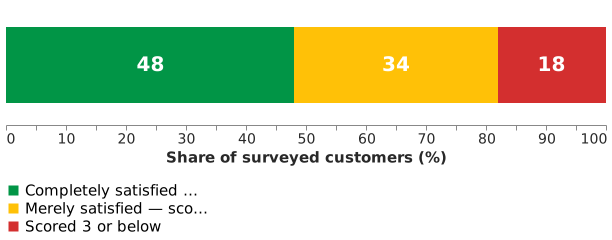 The 82% headline, split. [1]
2. The types, and what they look like in software
Hoover credits the taxonomy to Jones and Sasser in place [2]. The software readings below are ours, not the sources’.
| Type | In the source | In a software product |
|---|---|---|
| Loyalist / apostle | Completely satisfied; the apostle tells others | Renews without a conversation; answers questions in your community forum; gives the reference call |
| Defector | Dissatisfied, neutral — and the merely satisfied | Renews once, then silently does not. Usage decays months before the renewal date |
| Terrorist | “Can’t wait to tell others about their anger and frustration” | Takes the outage to the public issue tracker, or to a competitor’s procurement reference call |
| Mercenary | Completely satisfied, no loyalty | Acquired on a migration credit, gone at the first competitor promotion |
| Hostage | “Stuck… must accept it” | The internal user of a mandated system; the customer locked in by data gravity and an export format nobody implemented |
3. The two types you are manufacturing yourself
Terrorists and hostages are both produced by something the organisation is doing, which is what makes them worth separating from the others.
A hostage is a satisfied-looking number produced by the absence of a choice, and Jones and Sasser name the moment it stops being real: “the curve snaps.” Their case is a corporate PC user who cannot pick the standard — until purchasing replaces the fleet, at which point accumulated end-user dissatisfaction lands all at once. In software the snap has four familiar triggers: a re-tender, a platform migration, an API deprecation, and a competitor launching a free tier. Every green satisfaction score on a mandated internal system should be read against that list.
The repair mechanism in the literature is recovery rather than prevention: at one company studied, 35% of defectors were recaptured simply by contacting them and listening. A well-handled failure is the only documented route from defector to apostle — which is why postmortems, credits and a public status page are project management rather than public relations.
4. What this does not tell you
The types describe a customer’s current position, not its cause, and the taxonomy carries no threshold: nothing here says at what point a merely-satisfied account becomes a defector, or how long a hostage stays. It is a diagnostic vocabulary for a conversation about accounts, not a segmentation you can compute. Nor does it survive contact with a customer who has no alternative and never will — a regulator-mandated filing system has hostages by construction, and the useful question there is about the cost of their dissatisfaction, not their loyalty.
How solid is this?
- Where it comes from. A 1995 Harvard Business Review article drawing on more than 30 companies across five markets, with the underlying studies named — J.D. Power on 32 automobile nameplates, roughly 10,000 patient surveys, about 20,000 airline passengers.
- What is contested. Nothing in the taxonomy. But the evidence is correlational throughout; nothing establishes that raising satisfaction causes loyalty rather than the reverse.
- What we do not hold. One software case between this article and its companion, so the percentages belong to other industries. The types have not been validated on software products.
Acknowledgments
This page adapts material from lectures by Eduardo Miranda and David Root [3] on software project management.
References
- T. O. Jones and W. E. Sasser,“Why Satisfied Customers Defect,” Harvard Business Review, vol. 73, no. 6, pp. 88–99, Nov. 1995, [Online]. Available: https://hbr.org/1995/11/why-satisfied-customers-defect
- C. L. Hoover, M. Rosso-Llopart, and G. Taran,Evaluating Project Decisions: Case Studies in Software Engineering. Addison-Wesley Professional, 2010. [Online]. Available: https://www.oreilly.com/library/view/evaluating-project-decisions/9780321685629/
- D. Root,Managing Software Development. Carnegie Mellon University / Innopolis University lecture series, 2014.
Disclaimer: AI is used for text summarization, polishing and explaining. Authors have verified all facts and claims. In case of an error, feel free to file an issue.