Scope
This area is about two questions every plan has to answer before it can promise anything: what exactly will be delivered, and how big is it. They come in that order, because the second is asked of the first. A work breakdown structure turns a vague scope into a complete list of deliverables; estimation then sizes that list and derives effort and schedule from the size. RAND’s review of cost estimating puts the weight where it belongs: the chance that an estimate lands far from the actual cost “depends more on accurate size estimates than on any other cost-related parameter” [1].
Two sections follow, in the order a project meets them.
- WBS — how to decompose a project into deliverables so that nothing is missing and nothing is counted twice, and which orientation answers which management question.
- Estimates — how to turn that scope into size, effort and schedule: expert judgment, group techniques, function points and parametric models, and how to combine them.
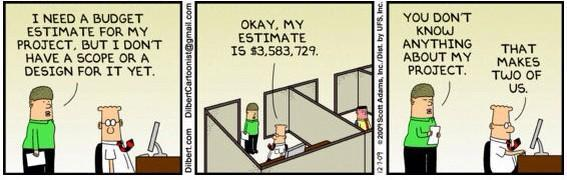
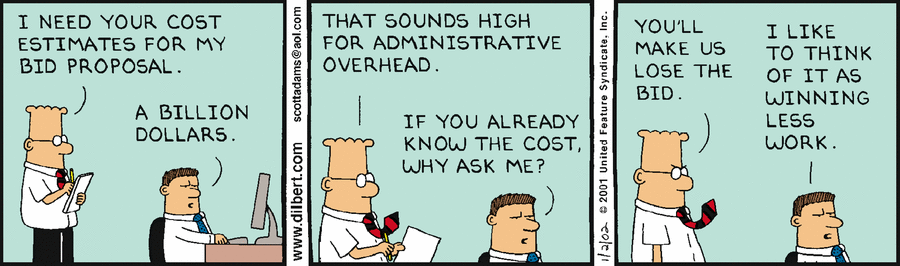
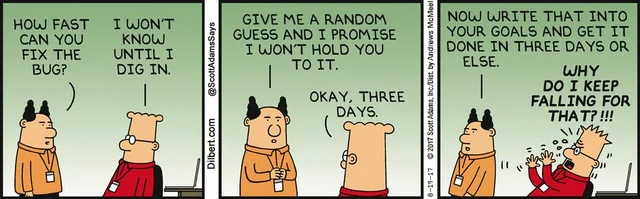
The strips below are a reminder of what happens when either step is skipped.

References
- S. L. Pfleeger, F. Wu, and R. Lewis,“Software Cost Estimation and Sizing Methods: Issues and Guidelines,” RAND Corporation, Monograph MG-269, 2005.
Disclaimer: AI is used for text summarization, polishing and explaining. Authors have verified all facts and claims. In case of an error, feel free to file an issue.