Resource planning
Resource planning fits a schedule to the people who will do the work: how many are needed week by week, whether anyone is booked beyond their availability, and which tasks move when they are. Levelling is the step that moves them, inside the dates the network allows [1].
1. The resource-use curve
Plot the number of full-time people the plan needs, week by week. The area under the curve is the total effort, so the curve shows where the estimate peaks. Draw it from real availability, not head-count: Rubin measures capacity after meetings, other commitments, time off and a buffer, and checks skills as well as hours [2]. Pressman calls the check effort validation: “no more than the allocated number of people” may be scheduled at any moment [3].
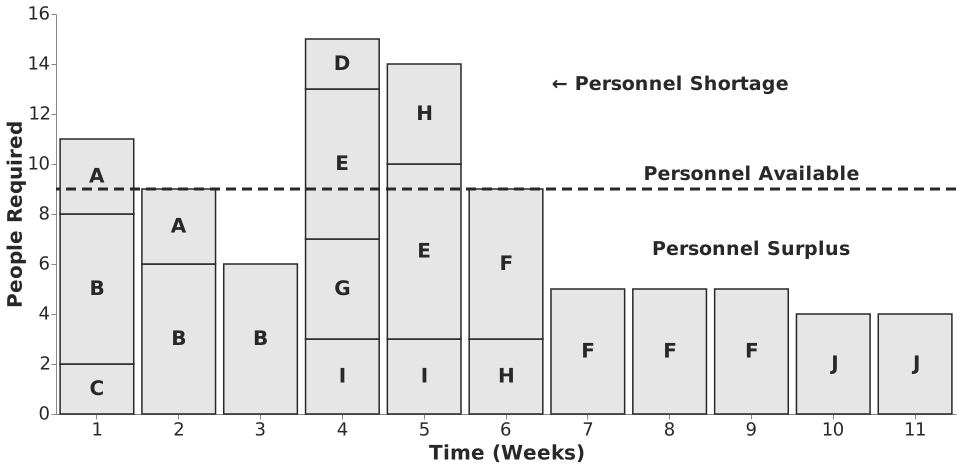
DSMC 2001, Scheduling Guide for Program Managers, Fig. 6-12 [4].
2. Why the network date is not the delivery date
The critical path is computed without people: “Considerations of available manpower and equipment are conspicuous by their absence.” When its inventors added them, a plan needing 27 mechanics where 8 were available had a critical path about 20% longer [5]. The network date is what the logic allows; the levelled date is what the team can deliver.
3. How levelling works
Levelling has two goals: nobody above 100% of their availability, and a head-count that rises and falls smoothly. Wysocki offers three strategies [1]:
- Use float. Move tasks that have room, free float first so no one else is disturbed, then total float. People go to the tasks with least float [5].
- Move the finish date when float runs out.
- Smooth with limited overtime, which Wysocki calls “your final fall-back option”.
A task can also be split around a person’s free days, stretched at a lower share of their time, or given to a less experienced person if it is not critical. Wysocki’s summary: “It should be obvious to you that resource leveling almost always stretches the schedule.”
4. Example: Dana in the Quill plan
Quill is a fictional word processor nine weeks from going live. For example, Dana owns its ten citation styles, a two-week task with four weeks of total float. The publisher then asks her to speed up the citation engine on long documents, part of the critical tuning task. The network sees no conflict; levelling sees one Dana.

Moving her citation styles later spends float the path already has, so go-live holds, although the accessibility review behind them slides too. Delaying the tuning work instead would move go-live week for week. That is the whole levelling decision: the person goes to the critical task, and the other task spends its float.
5. Brooks’s law
Adding people is the obvious fix for a late plan. “Cost does indeed vary as the product of the number of men and the number of months. Progress does not.” Newcomers must be trained by the people doing the work, the task must be repartitioned, and communication paths grow as n(n−1)/2. Hence, “Oversimplifying outrageously”: “Adding manpower to a late software project makes it later” [6].
Twenty years on, Brooks reported Abdel-Hamid and Madnick’s softer finding: adding people “always makes it more costly, but it does not always cause it to be completed later”. Add them early, if at all [6], and “be sure that you’ve assigned them work that is highly compartmentalized” [3].
6. When to use it, and where it misleads
Level once the sequence works: order first, people second [1]. Inside a Scrum sprint the team checks its own capacity instead.
Levelling is a heuristic, and tools disagree: seven commercial packages averaged 4.39% to 9.76% above the shortest feasible schedule [7]. Once resources shape the longest path, it runs through people as well as tasks, which is where critical chain starts.
How solid is this?
- Where it comes from. Textbooks, the critical-path inventors’ report and an essay collection. None tests levelling rules on software projects; the package figures are a 1999 benchmark on test instances, cited by Herroelen and Leus.
- What is contested. Brooks calls his law “the best zeroth-order approximation to the truth”, not a model.
- What is ours. The Quill plan is constructed, and the resource-use curve comes from the lecture, not a published source.
Acknowledgments
This page adapts material from lectures by Eduardo Miranda [8] on software project management.
References
- R. K. Wysocki and R. McGary,Effective Project Management: Traditional, Adaptive, Extreme, 3rd ed. Wiley Publishing, 2003.
- K. S. Rubin,Essential Scrum: A Practical Guide to the Most Popular Agile Process. in Addison-Wesley Signature Series (Cohn). Addison-Wesley Professional, 2012. [Online]. Available: https://innolution.com/essential-scrum
- R. S. Pressman,Software Engineering: A Practitioner’s Approach, 7th ed. McGraw-Hill, 2010.
- J. E. Kelley Jr. and M. R. Walker,“Critical-Path Planning and Scheduling,” in Papers Presented at the December 1–3, 1959, Eastern Joint IRE-AIEE-ACM Computer Conference, ACM, 1959, pp. 160–173. doi: 10.1145/1460299.1460318.
- F. P. Brooks,The mythical man-month (anniversary ed.). Addison-Wesley Longman Publishing Co., Inc., 1995.
- W. Herroelen and R. Leus,“On the Merits and Pitfalls of Critical Chain Scheduling,” Journal of Operations Management, vol. 19, no. 5, pp. 559–577, 2001, doi: 10.1016/S0272-6963(01)00054-7.
- E. Miranda,“Managing Software Development.” 2014.
Disclaimer: AI is used for text summarization, polishing and explaining. Authors have verified all facts and claims. In case of an error, feel free to file an issue.