SN L3c — Risk Management
A revision summary of the third Needs lecture. It follows the invented Quill project from the requirements lecture, four months before release 1.0, with four worries on the team’s whiteboard: the 2-second target was only tested with 100-page documents; only one developer understands the citation engine; the PDF engine vendor is late; the EU data-centre contract is unsigned. Six parts take those worries through the loop: find, write, size, respond, track. Each section links to the handbook page carrying the detail and the sources.
1. What risk management is
A risk is “uncertainty that, if it occurs, will affect achievement of objectives” [1]. The second half does the work: a risk has to threaten a named objective, and a worry that threatens none is news, not a risk. The threshold of success from the expectations lecture is a second filter: a concern that would not break it is an event the project can absorb.

If there is no uncertainty left, it is an issue. For example, halfway through a build somebody notices the system stores personal data and nobody has done a GDPR assessment. The missing assessment is certain, so it is an issue: resolve it. What the assessment will find is uncertain, so there is also a risk: if it finds a problem, the launch slips. One situation, two entries, two verbs: a risk is mitigated, an issue is resolved [2].
Risks come in three degrees of knowing [3]. Known: somebody can name it today, so write it down. Predictable: past projects saw it, so go and look. Unpredictable: nobody can name it, and the only answer is a reserve. A project with no reserve has decided the third category is empty, and it never is.
Exposure is probability times impact [4]. Quill’s performance risk is 0.4 likely with three weeks of delay, so 1.2 weeks of exposure; the developer leaving is 0.2 likely with six weeks, also 1.2. Exposure lets you compare risks that look nothing alike, and compare what you could do about them: the right option is the one that leaves the least exposure plus its own cost, which is why paying for an independent review can be the cheapest choice. The number is an estimate, not a measurement; its job is to survive being argued with.
Risk is not bad; unmanaged risk is [5]. Five levels of maturity run from crisis, through fixing and mitigating, to preventing and anticipating, and at the first three the schedule battle is already lost. The SEI loop is the spine of the lecture: identify, analyse, plan, track, control, with communication in the middle [6]. Every framework you will meet has this loop and differs only in its menu of responses.
→ Risks
2. Finding risks
Five techniques, chosen by where the knowledge is. Write the threshold of success first: when will it be, what will it be, what makes it a success. A concern that would break it is a risk [7]. Run a premortem: declare the project failed, in the past tense; write reasons privately for two minutes; read them round-robin; revise the plan. Dissent becomes the assigned task, so it costs nothing to voice [8]. Ask taxonomy questions when a team lists only product risks: the questions exist to make it ask about its development environment and the constraints it does not control, and the cues under each question turn fine into we have not measured that [9]. Use a checklist for a fast first pass; Boehm’s ten most common risks start with personnel shortfalls, people before technology [4]. And interview peers only: in the SEI’s field study a reporting relationship in the room always inhibited the subordinates, so run groups of at most five without a supervisor and give the manager an unattributed copy. Fewer than fifteen statements from a session means it did not work, not that the project is safe.
Most of a project’s risks are already known to somebody who is not in the meeting. Sessions surprised management every time in fifteen field tests, so a long register is evidence of honest identification, not of a failing project.
3. Writing a risk down
Start from a condition you can check today, then the consequence if nothing changes [2]. The 2-second target has only been tested with 100-page documents, so acceptance fails on big documents and release 1.0 slips. Only one developer understands the citation engine, so if she leaves, citations slip by six weeks. Each condition is a fact in the test log or the team list, not an opinion, and that is what separates a risk from a worry.
Condition-then-consequence, if–then and because–event–consequence carry the same elements; use the first unless your team has a standard, and whichever you use, the consequence carries a number and a unit [10]. Delays is not a consequence; three weeks is, because Part 4 is nothing but comparisons.
A register row holds the statement; probability, impact and exposure; one named owner; the response; a trigger and contingency; and the status with its last change [11]. Quill’s row R-01 reads: statement as above; 0.4, 3 weeks, 1.2 weeks; owner the tech lead; response reduce: build a 500-page test set and run it this sprint; trigger if the test shows more than 2 seconds on 1 November, switch to lazy page loading; open. A row without an owner is a worry. A row without a trigger is a plan that never starts.
Two well-formed statements are still useless [12]. If the publisher changes the requirements, the schedule slips points at a lever you do not hold; rewrite it towards your own change process. If we do not test with big documents, performance fails is not a risk but a decision not to do the work.
→ Capturing, owning and mitigating
4. Deciding which risks matter
Use scales with numbers, and write them down: probability high above 70%, medium about 50%, low below 30%; impact high at a schedule slip over 20% or cost over 25% [13]. Two people scoring the same row then land on the same band. Other organisations draw the lines elsewhere, and a government standard calls a 10% overrun catastrophic [14]; the words never agree, the numbers beside them do.
Finding a hundred risks takes half an hour and analysing thirty takes an hour, so vote first: each person gets a third of the count plus one votes, spends them anywhere, and the most-voted rows are analysed first. Estimate probability by convergence, polling the team round-robin until the estimate stops moving, never by the most senior person’s announcement [10].
Then sort by exposure and draw the line. Roughly 80% of the exposure sits in 20% of the risks [3]: compute, sort, draw, and write down what you will not do. Most of the risks you found never get a plan, and that is the method working as long as the decision is recorded.
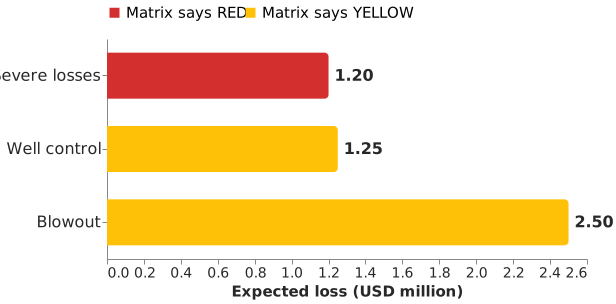
A colour is not a number. NASA says of its own matrix that it “is not an assessment tool, but can facilitate risk discussions” [11]. In Cox’s oil-well case the matrix paints severe losses red and the rarer blowout yellow, while the blowout’s expected loss is twice as large [15]. Start the conversation with the matrix; settle the order with exposure.
The distribution behind all this is fat-tailed. Across 5,392 IT projects half come in on budget or better and the average is 80% over, because a few go catastrophically wrong [16]. Size the reserve for the tail, not the average, and fund the components everything else depends on.
→ Analysis and prioritisation · Why we misjudge risk
5. Responding and tracking
Every register row has one of four responses [17]. Avoid: change the plan so the risk cannot happen; load pages lazily, so document size stops mattering. Reduce: lower the probability or the impact now; build the 500-page test set this sprint. Transfer: make someone else carry it; a delivery date and a penalty in the vendor’s contract. Accept: live with it and watch; re-check the EU contract on the first of every month. Whatever you choose, write a contingency with a trigger, and respond only if the response costs less than the exposure it removes.

Where a risk sits decides the kind of response: prevent the high band, prepare for the middle, monitor the low band [13]. The bands run diagonally because exposure is a product. The band picks the kind; the exposure number picks the order.
Tracking has three instruments. A top list with last week’s rank beside this week’s [18]: the was column is the meeting, reviewed weekly with the project manager’s boss present, and the trend of total exposure is what the sponsor sees. A burn-down plan of dated actions, each with a test for done, because “meetings do not burn down risks” [17]; testing you were always going to do mitigates nothing. And a cost: half a day once, identifying against the threshold of success, then ten to fifteen minutes a sprint, with mitigations as real backlog items and triggers checked at the sprint boundary [19]. One team with a risk manager and a spreadsheet mitigated nothing for several sprints, because the work sat in the backlog as one generic task nobody could estimate.
6. The case: Comair, Christmas 2004
Comair’s crew-scheduling system, built in 1986, had a hard ceiling of 32,000 trip transactions a month. A replacement was proposed in 1997 and rejected on good grounds, then deferred again and again: Y2K, an acquisition, a strike, 9/11 [20]. A storm before Christmas 2004 added more than 6,000 changes to a month already in progress, and on Christmas Eve the system stopped: 89% of flights cancelled or delayed, about 269,000 passengers affected.

Three lessons carry to any project. The storm was the trigger; the cause was a limit nobody re-examined. The probability rose every year as the airline grew, with no decision taken, so a register with one static probability column could not have shown it. And we are already replacing it is a schedule, not a mitigation: the approved replacement was in testing when the outage came.
→ Capturing, owning and mitigating
Where this goes next
This closes the Needs block. The case session that follows asks for a threshold of success and a register on a real case, where a risk is exactly what §2 said: a concern that would breach your own threshold, written as a row with an owner and a trigger.
Acknowledgments
This content is heavily inspired by and adapted from lectures by Eduardo Miranda and David Root [13] on software project management. The structure, examples, and pedagogical approach reflect their teaching materials and frameworks.
References
- D. Hillson,Managing Risk in Projects. in Fundamentals of Project Management. Gower, 2009.
- D. P. Gluch,“A Construct for Describing Software Development Risks,” Software Engineering Institute, Carnegie Mellon University, Technical Report CMU/SEI-94-TR-14, July 1994.
- R. S. Pressman,Software Engineering: A Practitioner’s Approach, 7th ed. McGraw-Hill, 2010.
- B. W. Boehm,“Software Risk Management: Principles and Practices,” IEEE Software, vol. 8, no. 1, pp. 32–41, Jan. 1991, doi: 10.1109/52.62930.
- R. L. Van Scoy,“Software Development Risk: Opportunity, Not Problem,” Software Engineering Institute, Carnegie Mellon University, Technical Report CMU/SEI-92-TR-30, Sept. 1992.
- A. J. Dorofee, J. A. Walker, C. J. Alberts, R. P. Higuera, R. L. Murphy, and R. C. Williams,Continuous Risk Management Guidebook, no. CMU/SEI-96-HB-002. Software Engineering Institute, Carnegie Mellon University, 1996.
- C. L. Hoover, M. Rosso-Llopart, and G. Taran,Evaluating Project Decisions: Case Studies in Software Engineering. Addison-Wesley Professional, 2010. [Online]. Available: https://www.oreilly.com/library/view/evaluating-project-decisions/9780321685629/
- G. Klein,“Performing a Project Premortem,” Harvard Business Review, vol. 85, no. 9, pp. 18–19, Sept. 2007, [Online]. Available: https://hbr.org/2007/09/performing-a-project-premortem
- M. J. Carr, S. L. Konda, I. Monarch, F. C. Ulrich, and C. F. Walker,“Taxonomy-Based Risk Identification,” Software Engineering Institute, Carnegie Mellon University, Technical Report CMU/SEI-93-TR-6, June 1993.
- R. C. Williams, G. J. Pandelios, and S. G. Behrens,“Software Risk Evaluation (SRE) Method Description, Version 2.0,” Software Engineering Institute, Carnegie Mellon University, Technical Report CMU/SEI-99-TR-029, Dec. 1999.
- NASA,“NASA Systems Engineering Handbook,” National Aeronautics and Space Administration, NASA Special Publication SP-2007-6105 Rev1, Dec. 2007. [Online]. Available: https://www.nasa.gov/reference/systems-engineering-handbook/
- J. Thompson and S. Stump,“How to Write a Good Risk Statement,” Defense AT&L, Nov. 2017, [Online]. Available: https://www.dau.edu/library/damag/november-december2017/how-write-good-risk-statement
- D. Root,Managing Software Development. Carnegie Mellon University / Innopolis University lecture series, 2014.
- U.S. Department of Energy,“Software Risk Management A Practical Guide,” U.S. Department of Energy, Technical Standard SQAS21.01.00, 2000. [Online]. Available: https://energy.gov/sites/prod/files/cioprod/documents/Risk_Management.pdf
- L. A. Cox,“What’s Wrong with Risk Matrices?,” Risk Analysis, vol. 28, no. 2, pp. 497–512, Apr. 2008, doi: 10.1111/j.1539-6924.2008.01030.x.
- B. Flyvbjerg, A. Budzier, J. S. Lee, M. Keil, D. Lunn, and D. W. Bester,“The Empirical Reality of IT Project Cost Overruns: Discovering a Power-Law Distribution,” Journal of Management Information Systems, vol. 39, no. 3, pp. 607–639, 2022, doi: 10.1080/07421222.2022.2096544.
- Office of the Under Secretary of Defense for Research and Engineering,“Risk, Issue, and Opportunity (RIO) Management Guide for Defense Acquisition Programs,” U.S. Department of Defense, Sept. 2023.
- S. McConnell,Rapid development: taming wild software schedules. Pearson Education, 1996.
- C. R. Nelson, G. Taran, and L. de Lascurain Hinojosa,“Explicit Risk Management in Agile Processes,” in Agile Processes in Software Engineering and Extreme Programming, P. Abrahamsson, R. Baskerville, K. Conboy, B. Fitzgerald, L. Morgan, and X. Wang, Eds., in Lecture Notes in Business Information Processing. Springer, 2008, pp. 190–201. doi: 10.1007/978-3-540-68255-4_20.
- U.S. Department of Transportation, Office of Inspector General,“Air Carrier Flight Delays and Cancellations,” U.S. Department of Transportation, SC-2005-051, July 2005.
Disclaimer: AI is used for text summarization, polishing and explaining. Authors have verified all facts and claims. In case of an error, feel free to file an issue.