Social Loafing
Social loafing is the tendency of people in groups not to work as hard as they do alone [1] (p. 47). Team output still rises with team size, but “the rate of increase is negatively accelerated, such that the addition of new members to the team has diminishing returns on productivity” (p. 47).
1. Ringelmann, and the mechanism
The classic demonstration is Ringelmann’s rope-pulling experiment: “as more people pulled the rope, the total force exerted by the group as a whole rose but the average force exerted per person dropped” [2] (p. 296). The potential-versus-actual arithmetic behind it is on Team Performance, where loafing is the motivation-loss half of Steiner’s equation.
The mechanism has a name: social impact theory. The social force acting on a group is divided among its members, so “the responsibility for doing the job is diffused over more people” and the larger the group, the less pressure any individual feels (p. 296).
Thompson gives three causes [1] (p. 49). Diffusion of responsibility: individual contributions cannot be told apart, so nobody feels accountable. A reduced sense of self-efficacy: members come to believe their own effort cannot change the outcome. Sucker aversion: the fear of doing all the work and getting a fifth of the credit. Example: at a hackathon one person codes all night while the others brainstorm, and all four put the project on their CV.
2. The free-rider problem, old and new
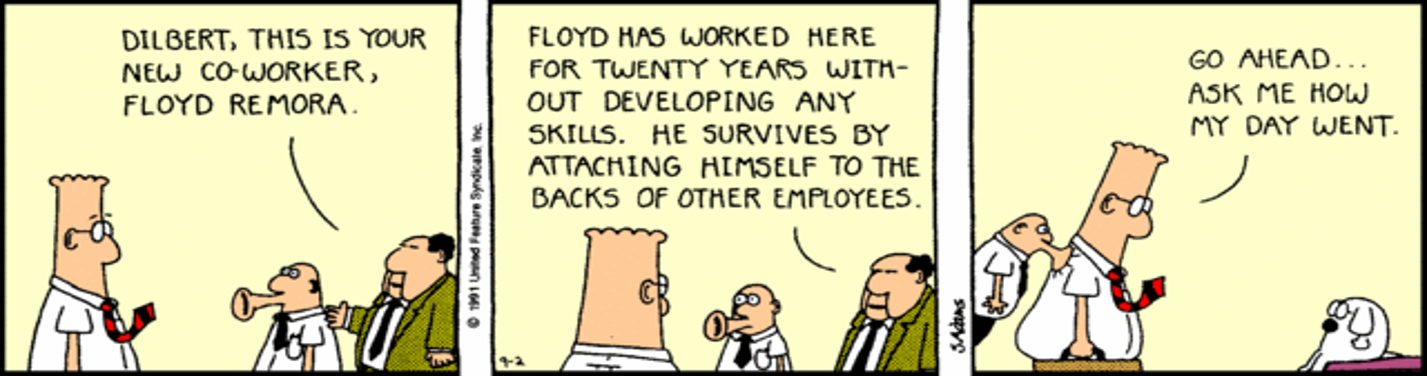
A free rider contributes less and relies on others to carry the workload. The classic case is withdrawal of effort; the modern one is not. In 2,755 open-source repositories around the arrival of AI coding assistance, peripheral contributors did not withdraw — they produced 43.5% more commits and 17.7% more pull requests, while core developers reviewed 6.5% more code and their own commit output fell 19% [3]. The cost still landed on the core, through volume rather than idleness. Free riding here is structural: nobody has to feel anything for the imbalance to appear, and the resource being consumed — senior attention — appears on no dashboard.
3. What reduces it
Thompson’s remedies, in her order (pp. 50–53), all attack one of the three causes: increase identifiability so contributions can be seen, promote involvement in the work itself, reward members for performance, strengthen cohesion, increase personal responsibility through clear individual ownership, give the team performance and review feedback, and keep staffing appropriate to the task rather than generous.
The qualification that is usually dropped: “the key is not identifiability per se, but rather the evaluation that identifiability makes possible” (p. 51) [1]. A dashboard of who committed what reduces nothing unless somebody acts on it — and in a team where a growing share of the code is generated rather than written, that evaluation is the first thing to degrade.
4. Loafing with a machine in the loop
Stieglitz and colleagues measured loafing tendencies when the collaborator is a virtual assistant [4]. A self-reported tendency to loaf in human groups still predicted low-effort behaviour with the assistant (r = 0.344), but the traits that protect a human team stopped predicting: conscientiousness fell from r = −0.496 (p < .001) to −0.125 (ns), need for cognition from −0.406 to −0.187 (ns). With no colleague to feel the slack, agreeableness has nothing to act on. Effort correlated negatively with loafing (r = −0.309) while frustration did not move (r = −0.034, ns), which the authors read as task offloading rather than disengagement — smart loafing, which they argue may be benign.
Put beside the free-rider finding above: offloading effort is smart only if nobody downstream is paying for it. Stieglitz’s claim that “no other human team member needs to compensate” is exactly what [3] tests at scale and does not find.
How solid is this?
- Loafing is not a human universal. Greenberg’s own section asks the question and reports that the effect reversed in the People’s Republic of China and in Israel, where working in a group produced more effort, not less (p. 297). That is one reported study rather than a meta-analysis, so it is not a finding about any individual either. Loafing is contingent on context.
- Which Greenberg. This material is often attributed to “Greenberg, 1996, Managing Behaviors in Organizations” — a title that does not exist. The source is Jerald Greenberg, Behavior in Organizations, 10th ed., 2011 [2].
- The virtual-assistant study has no control condition. Every participant had the assistant and nobody worked alone, so no effort decrement against a solo baseline was ever measured. Two of its six loafing items measure tool usefulness, so a participant who was genuinely helped scores as a loafer. The sample was 102 people, 81.4% still studying — and the authors carve out an exception worth saying aloud in a university: “smart loafing in, for instance, learning environments might be hindering and not ‘smart’.”
- The AI free-rider study is observational. Its treatment is a programming language in a period rather than observed tool use,
*denotes p < 0.1 throughout, and its own headline “42.9%” is miscomputed — for the stated coefficient the change is −30.0%.
Acknowledgments
This page adapts material from lectures by Eduardo Miranda and David Root [5] on software project management.
References
- L. L. Thompson,Making the Team: A Guide for Managers, 5, Global. Pearson Education Limited, 2015.
- J. Greenberg,Behavior in Organizations, 10, Global. Pearson Education Limited, 2011.
- F. Xu, P. K. Medappa, M. M. Tunc, M. Vroegindeweij, and J. C. Fransoo,“AI-Assisted Programming Decreases the Productivity of Experienced Developers by Increasing the Technical Debt and Maintenance Burden,” 2025.
- S. Stieglitz, M. Mirbabaie, N. R. J. Möllmann, and J. Rzyski,“Collaborating with Virtual Assistants in Organizations: Analyzing Social Loafing Tendencies and Responsibility Attribution,” Information Systems Frontiers, vol. 24, pp. 745–770, 2022, doi: 10.1007/s10796-021-10201-0.
- D. Root,Managing Software Development. Carnegie Mellon University / Innopolis University lecture series, 2014.
Disclaimer: AI is used for text summarization, polishing and explaining. Authors have verified all facts and claims. In case of an error, feel free to file an issue.