Stakeholders
“A stakeholder is a person or organization who influences a system’s requirements or who is impacted by that system” [1]. Note what the definition does not require: a stakeholder need not use the system, pay for it, or want it to exist.
Stakeholder identification comes first, and the source says so plainly: “stakeholder identification precedes any other RE activity: we must first determine who they are and how important they are.”
1. Seven categories to scan
The two that a wish-gathering exercise never produces are the last two.
- People with an active interest in the system.
- People who will operate or maintain it after deployment.
- People who develop it.
- People responsible for the business process it supports.
- People with a financial interest.
- Regulators — legal, safety, standards, audit.
- People who are negatively affected by it.
2. The onion: draw the missing people rather than forgetting them
Alexander and Robertson model stakeholders as four rings around the thing being built [2]: the kit (the product itself), our system (the kit plus the people who operate, maintain and deliver its results, and the rules they work to), the containing system (plus beneficiaries who never touch it), and the wider environment.
The ring that does the work is our system versus the kit, and the authors make the case in one sentence: “even an automatic product such as a missile only works when people test, install, and launch it.”
The mechanism that makes the model useful is the slot. A slot is a generalised role; a filled slot is drawn solid, an unfilled one greyed out. An empty slot is a finding; a missing person is just invisible. A model with 11 slots, 5 roles filled and 7 empty tells you where the next conversation goes. It also exposes slots that are wrong rather than merely empty. For example, one model showed two departments each believing they held purchasing authority; another hid workplace safety, airworthiness certification and radio regulation inside one generic regulator slot.
 An empty slot is a finding. [2]
3. Prioritise on the risk of neglect, not on seniority
Once the roles exist, rank them by what happens if you ignore them [1]: critical — neglect might kill the project or render the system useless; major — significant negative impact; minor — marginal. Then, and only then, pick the individuals who will represent each role.
The order matters because the loudest stakeholder is rarely the one whose neglect is most expensive.
4. Finding them is the easy part
This is the finding that reframes the topic. Asked to name the single stakeholder concern causing the biggest problem in their own work, 541 practitioners answered [2]:
| Concern | Responses |
|---|---|
| Skill — stakeholders cannot take part usefully; they describe solutions, and change their minds | 208 (38%) |
| Commitment — people with authority will not commit time or budget | 186 (34%) |
| Discovery — we cannot find the appropriate stakeholders | 72 (13%) |
| Maintaining the stakeholder set | 48 (9%) |
| Other | 27 (5%) |
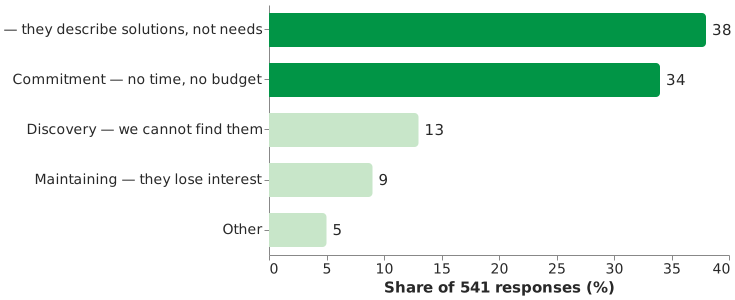 541 practitioners. Discovery is fourth. [2]
Discovery came fourth. Together, skill and commitment account for 72%. The hard part is not locating people; it is getting the people you located to engage usefully — which is what elicitation and customer involvement are about.
5. The model rots, and here is how you notice
A stakeholder model is not a one-off exercise. Four indicators say it needs revisiting: reorganisations and renamed departments; hiring and firing — “when an occupant leaves a role, he or she often forgets to inform the new role occupant of his or her stakeholder responsibilities”; boundary changes such as new functionality or a new law; and missing feedback loops, because “unless you can keep your project in the limelight, people lose interest.”
The consequence is stated flatly: “missing stakeholders result in missing requirements and escalating project costs.”
How solid is this?
- Where it comes from. A three-page IEEE editorial supplying a definition and a prioritisation rule, and a practitioner article presenting the onion model with a survey. Both are method rather than measurement.
- What is contested. Nothing in the models themselves — but running two of them is recommended by their own authors, “because people who have been using one model might overlook a role that the other model immediately suggests.”
- What we do not hold. The 541-response survey is a convenience sample gathered at 12 requirements workshops and tutorials — people who chose to attend a requirements session, and so the group most likely to name requirements problems as their biggest concern.
Acknowledgments
This page adapts material from lectures by Eduardo Miranda and David Root [3] on software project management.
References
- M. Glinz and R. J. Wieringa,“Stakeholders in Requirements Engineering,” IEEE Software, vol. 24, no. 2, pp. 18–20, Mar. 2007, doi: 10.1109/MS.2007.42.
- I. Alexander and S. Robertson,“Understanding Project Sociology by Modeling Stakeholders,” IEEE Software, vol. 21, no. 1, pp. 23–27, Jan. 2004, doi: 10.1109/MS.2004.1259199.
- D. Root,Managing Software Development. Carnegie Mellon University / Innopolis University lecture series, 2014.
Disclaimer: AI is used for text summarization, polishing and explaining. Authors have verified all facts and claims. In case of an error, feel free to file an issue.