Why Projects Fail
Adapted from lecture materials by David Root [1].
A software project counts as failed when it is cancelled or delivered outside its own forecast of time, cost and result — which, on the most-quoted industry figures, is what happens to most of them [2]. Read those figures closely: not because they are dependable, but because seeing why they are not is the first lesson of this course.
Neither number below measures what it appears to measure. Both definitions score a project against its own forecast, so an organization can raise its score by inflating estimates [3] — detail in How solid is this? below.
The same projects, two answers
Standish reports outcomes under two definitions, and the choice moves the headline by seven percentage points across the same 25,000 projects:
| Definition | What counts as success | FY2015 result |
|---|---|---|
| Traditional | OnTime, OnBudget, OnTarget — the required features | 36% successful · 45% challenged · 19% failed |
| Modern | OnTime, OnBudget, with a satisfactory result | 29% successful · 52% challenged · 19% failed |
The report states that “for the rest of this report CHAOS Resolution will refer to the Modern Resolution definition.” Quoting a size breakdown beside a “36% succeed” headline therefore mixes the two — an easy mistake to make, and a common one.
Outcomes by project size
In CHAOS 2015, under the Modern definition, larger projects do fare worse: 6% of Grand projects are recorded successful against 61% of Small ones.
| Project Size | Successful | Challenged | Failed | Total |
|---|---|---|---|---|
| Grand | 6% | 51% | 43% | 100% |
| Large | 11% | 59% | 30% | 100% |
| Medium | 12% | 62% | 26% | 100% |
| Moderate | 24% | 64% | 12% | 100% |
| Small | 61% | 32% | 7% | 100% |
None of this shows that software projects go well. It shows what to ask of any project metric you are handed: who chose the definition, and what happens to them if the number moves. That question returns in Tracking.
Despite decades of experience — Carnegie Mellon’s computer science department was founded in 1965, NASA has been building software since the 1950s — software remains harder to predict than most engineering disciplines. Two reasons recur.
Software is different
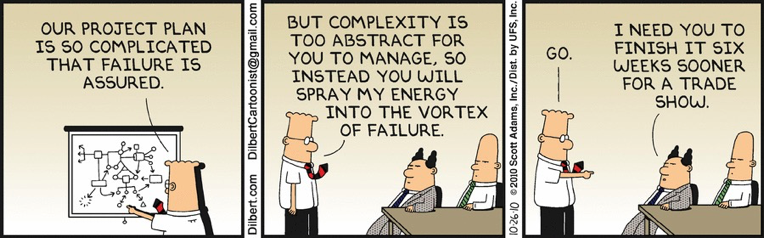
Software systems reach orders of magnitude more complexity than physical ones, and none of it is visible: product and process are both abstract, and many stakeholders fully understand neither. Because software is perceived as “soft” — easy to change — changes are requested casually and then have consequences nobody anticipated. Every project differs enough that few solutions transfer. For example, code written in BASIC and in C# compiles to the same machine code when both target the same architecture, yet the two development processes and their efficiency differ enormously.
The human variable
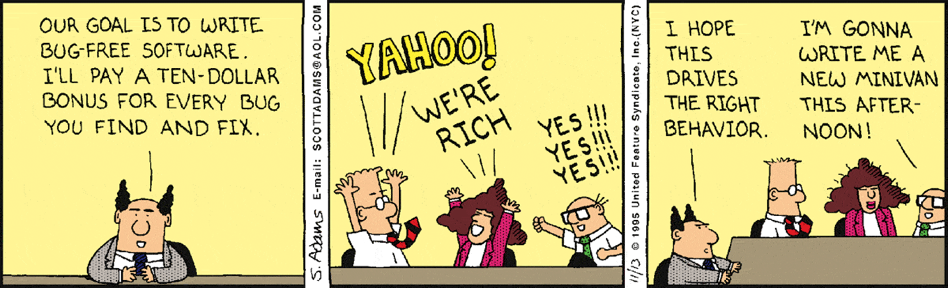
The number-one problem managers report is how to motivate people, and people resist standardization: experience varies, the ability to learn and execute a task differs, and interpersonal relationships change what a team can do. Behaviour is hard to predict and harder to control, and matching a person to a task — the first fit problem — is rarely right first time.
Constraining the human variable
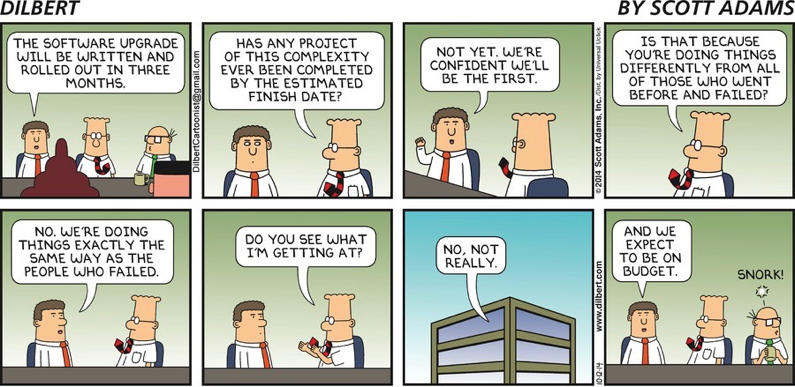
Management’s usual answer is process: define acceptable norms of behaviour, direct actions, standardize responses — “see A, do B”. Process improvement then refines how the work is done, and process checking confirms the process is followed and effective. Over-standardization has its own pitfall, the assembly-line problem: creativity and adaptability disappear. Communication in software teams has historically been poor, and no amount of process fixes that on its own.
Why study management of software development?
To understand why projects fail and how to improve the odds; to manage complexity and human factors rather than hope they behave; to apply engineering discipline while recognizing what makes software unlike other engineering; and to build skills in process design, team leadership and communication.
How solid is this?
- What is contested. Eveleens and Verhoef [3] analysed 5,457 forecasts across 1,211 real projects and showed what follows from scoring a project against its own estimate: the portfolio with the worst forecasting — half its projects out by 233% or more — scored 67% “successful”, because its managers systematically overstated budgets. Two datasets with identical forecast quality scored 5.8% and 94.2%, differing only in the direction of the bias.
- Three checks before using any figure like this. Who chose the definition? Standish’s own disclaimer, quoted by Eveleens and Verhoef, says its reports “should be considered Standish opinion and the reader bears all risk in the use of this opinion”. Does the publisher sell the remedy? The top-weighted success factor is “Optimization”, the name of Standish’s own paid service, and the text beside the size table offers to “break up large software projects into multiple small projects”. Does the report agree with itself? This one gives “25,000-plus projects” on page 1 and 50,000 on page 13.
- Frameworks, not measurements. “Software is different”, the human variable and the process response to it come from the Miranda and Root lectures [1]: teaching frameworks with practice behind them rather than measured findings. How much each of them contributes to a project’s outcome is still to be quantified.
Acknowledgments
This page adapts material from lectures by Eduardo Miranda and David Root [1] on software project management.
References
- D. Root,Managing Software Development. Carnegie Mellon University / Innopolis University lecture series, 2014.
- The Standish Group International,“CHAOS Report 2015,” The Standish Group International, Inc., 2015.
- J. L. Eveleens and C. Verhoef,“The Rise and Fall of the Chaos Report Figures,” IEEE Software, vol. 27, no. 1, pp. 30–36, 2010, doi: 10.1109/MS.2009.154.
Disclaimer: AI is used for text summarization, polishing and explaining. Authors have verified all facts and claims. In case of an error, feel free to file an issue.