Spiral
The spiral is a risk-driven lifecycle: each cycle identifies objectives and alternatives, evaluates them against the risks, resolves the dominant risk — often by prototyping — and only then commits to the next phase. Risk decides what happens next.
That is the answer to what is its major focus?, and it is what distinguishes the model. Barry Boehm states it as the defining property: “The major distinguishing feature of the spiral model is that it creates a risk-driven approach to the software process rather than a primarily document-driven or code-driven process” [1].
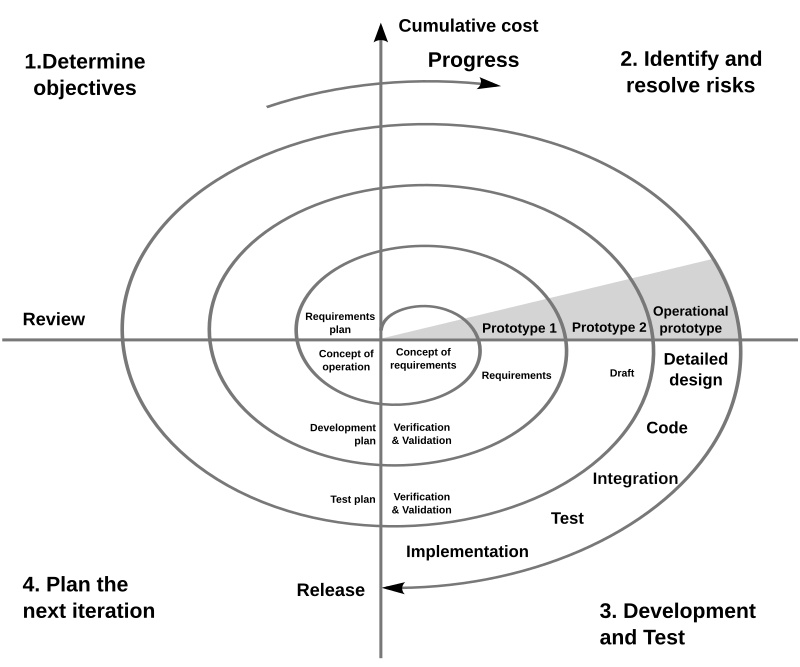
Diagram after Boehm 1988 [1]; this rendering is reproduced from Wikimedia Commons.
1. One cycle, four moves
Each loop repeats the same four steps, and the third is the one students skip:
- Objectives, alternatives, constraints — what are we trying to achieve on this pass, and what are the candidate ways of doing it?
- Evaluate alternatives, identify and resolve risks — the risk-resolution quadrant. Prototype, simulate, benchmark or model until the dominant uncertainty is retired.
- Develop and verify the deliverable for this cycle.
- Plan the next phase, and commit — or decide not to.
McConnell’s shorthand is that it is “a risk-oriented lifecycle model that breaks a software project up into miniprojects” [2]. The US Air Force guidebook makes the other useful point — the spiral is “an overlay of either incremental or evolutionary with the addition of risk management” [3], so it is not a rival to incremental delivery but a discipline laid over it.
Risk-driven does not mean the project is risky. It means the risks choose the next step. That distinction is the whole content of the model, and it is what the loops in the diagram obscure.
2. It subsumes the other models
A cycle in which product risk is low and budget or schedule risk is high “becomes equivalent to” the waterfall; one dominated by requirements uncertainty becomes evolutionary development [1]. So the spiral is less a seventh model than a rule for choosing among the others, one cycle at a time.
“Degenerates to” is not Boehm’s word, and the condition is two-sided — low user-interface and performance risk together with high budget or schedule risk, not simply “low risk”.
3. Where it does not fit
Boehm devotes a section to Difficulties, and it is more candid than most method papers [1]:
- Contract software. “The spiral model currently works well on internal software developments like the TRW-SPS, but it needs further work to match it to the world of contract software acquisition.” Deferred options and stage-by-stage commitment are hard to write into a fixed-deliverable contract.
- Risk-assessment expertise. The model is only as good as the judgement of whoever ranks the risks, and no procedure supplies that judgement.
- Elaboration. “Some difficulties must be addressed before it can be called a mature, universally applicable model.”
Example — where it was actually run. Boehm’s worked instance is TRW’s Software Productivity System: an internal environment of more than 300 tools and around 1,300,000 instructions, used by 25 or more projects, developed over a series of spiral cycles in which each pass funded the next [1].
So the “appropriate project” answer is a condition rather than a domain: use the spiral where you control the commitment points. Students usually guess large government programmes; Boehm says roughly the opposite — it works on internal development and needs further work for contract acquisition.
Boehm later extended the model with WinWin, which adds an explicit stakeholder-negotiation step at the start of each cycle to establish whose objectives the risks are being judged against.
How solid is this?
- One internal project, no control group. TRW-SPS is a detailed case, not an evaluation of the model against alternatives.
- The headline productivity claim needs its qualifier. Boehm reports gains of “at least 50%; indeed, most have doubled” — measured against cost-estimation model predictions, not against a measured baseline. Never repeat the figure without that. The separate 93% reuse figure describes SPS itself, not the 25+ projects; keep the two apart.
- McConnell’s Rapid Development is a practitioner book — a clean definition, not evidence.
- The STSC guidebook is grey literature — a US Air Force acquisition guide with no named author.
- Nothing here shows risk-driven selection produces better outcomes than any other basis for choosing a process. It is a coherent and influential tradition, not a measured one.
Acknowledgments
This page adapts material from lectures by Eduardo Miranda and David Root [4] on software project management.
References
- B. W. Boehm,“A spiral model of software development and enhancement,” Computer, vol. 21, no. 5, pp. 61–72, May 1988, doi: 10.1109/2.59.
- S. McConnell,Rapid development: taming wild software schedules. Pearson Education, 1996.
- “System Life Cycle and Methodologies.” US Air Force Software Technology Support Center, 1996.
- D. Root,Managing Software Development. Carnegie Mellon University / Innopolis University lecture series, 2014.
Disclaimer: AI is used for text summarization, polishing and explaining. Authors have verified all facts and claims. In case of an error, feel free to file an issue.