Requirements with LLMs
A large language model is useful on requirements work that is about text and unreliable on work that is about the world. The largest review of the field puts the boundary in one sentence: the “current generation of GenAI tools are best viewed as assistive accelerators rather than autonomous decision-makers for RE” [1]. This page is about using a model for requirements engineering, not requirements engineering for AI systems.
1. This is the fourth generation of the attempt
Automating requirements work is not new — findphrases (1990) through QuARS and SREE to aToucan (2015). A map of 404 studies found 130 tools built, 17 downloadable, and only 7% evaluated in industry [2]. The current generation is growing fast and barely deployed: of 238 studies to May 2025, over 90% are concept or proof-of-concept work and 1.3% reach production [1] — so the honest reading is not that it fails, but that almost nobody has run it in anger.
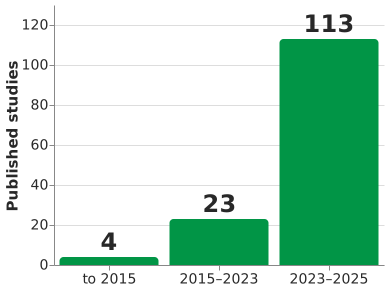 The fourth generation of requirements automation. [1]
2. Where it earns its place
The tasks that work share a shape — text in, text out, a checkable answer, no whole-project context needed: drafting, reformatting, classification, consistency checking.
For example, GPT-4 turned “Platform should withstand considerable amounts of traffic” into this [3]:
The platform must support up to 10,000 concurrent users and maintain functionality during peak usage times, such as event registration openings and result announcements.
That is the model applying the criteria on requirement statements, on request. Two findings are worth carrying: few-shot beats zero-shot by 15–25% on classification accuracy, so show it examples; and grounding beats prompting, since retrieval from the organisation’s own documents “can markedly improve reliability, reduce hallucinations” [1].
Drafting an SRS took 25–40 minutes against 4–24 hours by hand — though the authors note that SRS writing is a small share of project effort [3].
3. The failures that look like success
Hallucination is the failure everybody has heard of. Three others are worse, because the output looks fine.
- The model changes the requirement while improving it. Asked to correct a performance requirement, CodeLlama raised the response-time threshold, calling that a correction [3]. Read every corrected requirement against the original.
- Confidence does not track accuracy. Four people, same brief and same 45 minutes, scored against an expert baseline, reached precision of 82%, 53%, 29% and 15% — and the two at 29% and 15% “displayed a remarkable degree of confidence in their elicited requirements” [4].
- Volume looks like productivity. The weakest produced the most requirements: 27, of which 20 were superfluous.
Ask the same question twice and you may not get the same specification. Reproducibility (66.8%), hallucination (63.4%) and interpretability (57.1%) are the most-reported challenges, and they co-occur: the stochasticity that varies the output also makes it hard to explain [1].
4. Why the usual score is the wrong score
F1 weights precision and recall equally; requirements work does not. A missed requirement leaves an incomplete system; a false one costs a review [5]. So a checker should aim at the Perfect Recall Condition: catch everything, accept false alarms [6]. Even that is hard.
AQUSA, a user-story checker tuned for recall over 1,023 industrial stories, was defeated 38 times by an ampersand inside a company’s own job title — “As an Product Owner W&O” — and the cleverer fix made it worse, because taggers read select as a noun here. Your vocabulary is not the tool’s.
Since the best models score below 1.0, both error types persist, so the decision is per application, not per tool: what error rate is tolerable here?
5. What to do about it
Validate, then correct — score each requirement against explicit criteria, then rewrite only the failures. Keep it out of mission-critical, safety-regulated or compliance-heavy work without human oversight. Pilot rather than roll out, and demand a vendor’s prompts, datasets and human-judgment protocol: 73.1% of published studies withhold their tools. Two questions have no settled answer: what happens to stakeholder material entered into a public model, and who owns a requirement generated from unknown training data.
How solid is this?
- Where it comes from. Two systematic reviews (404 studies to 2019; 238 to May 2025), one survey, one four-person evaluation, one single-project experiment. None measures a requirements outcome against a traditional method.
- What is contested. Nothing between the sources, but the 2019 map predates generative models and is not evidence about them.
- What we do not hold. The model names and figures here date faster than anything else in this handbook. The mechanisms — stochastic output, false positives, automation bias, domain vocabulary defeating a tagger — outlast them.
References
- H. Cheng et al.,“Generative AI for Requirements Engineering: A Systematic Literature Review,” Software: Practice and Experience, vol. 56, no. 2, pp. 141–170, Feb. 2026, doi: 10.1002/spe.70029.
- L. Zhao et al.,“Natural Language Processing for Requirements Engineering: A Systematic Mapping Study,” ACM Computing Surveys, vol. 54, no. 3, pp. 55:1–55:41, Apr. 2021, doi: 10.1145/3444689.
- M. Krishna, B. Gaur, A. Verma, and P. Jalote,“Using LLMs in Software Requirements Specifications: An Empirical Evaluation,” in 2024 IEEE 32nd International Requirements Engineering Conference (RE), IEEE, June 2024, pp. 475–483. doi: 10.1109/RE59067.2024.00056.
- C. Arora, J. Grundy, and M. Abdelrazek,“Advancing Requirements Engineering Through Generative AI: Assessing the Role of LLMs,” in Generative AI for Effective Software Development, Springer Nature Switzerland, 2024, pp. 129–148. doi: 10.1007/978-3-031-55642-5_6.
- J. J. Norheim, E. Rebentisch, D. Xiao, L. Draeger, A. Kerbrat, and O. L. de Weck,“Challenges in Applying Large Language Models to Requirements Engineering Tasks,” Design Science, vol. 10, p. e16, 2024, doi: 10.1017/dsj.2024.8.
- G. Lucassen, F. Dalpiaz, J. M. E. M. van der Werf, and S. Brinkkemper,“Improving Agile Requirements: The Quality User Story Framework and Tool,” Requirements Engineering, vol. 21, no. 3, pp. 383–403, Sept. 2016, doi: 10.1007/s00766-016-0250-x.
Disclaimer: AI is used for text summarization, polishing and explaining. Authors have verified all facts and claims. In case of an error, feel free to file an issue.