Where Process Came From
Process thinking arrived in software from manufacturing, and it arrived with assumptions attached. Knowing which ones travelled and which ones did not explains most of the arguments in this block.
1. Two ideas from the factory
Adam Smith’s pin factory is the first statement of the case. Making a pin, he observed, is “divided into about eighteen distinct operations”, each performed by a different hand — and the output of ten specialists dwarfs what ten generalists could produce [1]. The claim is that dividing work into defined steps raises output.
Frederick Taylor turned that into a management programme: study the task scientifically rather than by rule of thumb, select and train the worker for it, supervise the execution, and split the work so that managers plan and workers execute [2]. The first three of those ideas are the ancestor of every process definition in this handbook. The fourth — planning separated from doing — is the one that keeps causing trouble, and it is exactly what defining a process rejects when it insists you ask the doers.
2. Deming moved quality upstream
Early quality control was terminal: design, build, test, discard the rejects. Quality was something you inspected for at the end, and defects were a cost of doing business.
W. Edwards Deming’s argument, carried into Japanese manufacturing from the 1950s, was that this is backwards [3]. If defects come from the process, then analysing the process and removing the causes prevents defects that inspection can only catch. Analyse processes, not just products; collect data to find the sources of defects; act before the defect occurs. The Plan-Do-Check-Act loop on defining a process is this idea in operational form.
Does that transfer to software, which is not stamped out in identical units? The SEI’s answer, and this course’s, is that it does — because the process repeats even when the product does not.
3. Why software needed it anyway
Software has properties that make an undefined process expensive. Two competent developers solve the same problem differently, and without an agreed process that variation reaches the product. You cannot see a software system, so you cannot spot a defect the way you can spot a bent pin. Requirements move underneath the work. And — the decisive one — defects propagate.
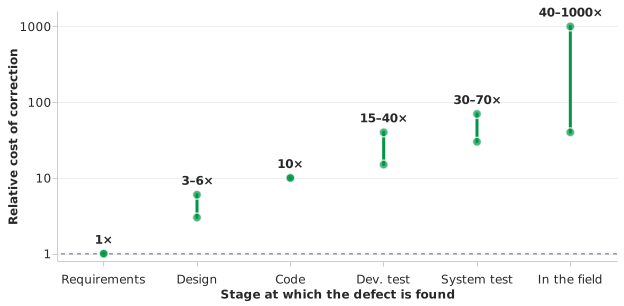
Example — a requirements defect that survives to release. A misunderstanding written into a requirements statement is copied into the design, honoured by the code, and confirmed by tests written from the same misunderstanding. Every stage does its job correctly; the error is carried, not caught. It surfaces in production as a system that works exactly as specified and not as needed — and by then the fix touches the specification, the design, the code and the tests [4].
That is why the work products before the code — estimates, requirements, architecture, test plans — are worth reviewing: each is a place a defect can enter and then be propagated.
4. So quality assurance is about the process too
The consequence is that QA cannot mean only testing the finished product. What limits how many defects were injected in the first place is the process that built it — so audits, inspections, standards such as CMMI, and formalised process definitions are quality activities in the same sense that testing is.
How solid is this?
- This is intellectual history, not evidence for a method. Smith, Taylor and Deming explain where process thinking comes from; none of them studied software, and none of the claims here rests on them being right about software.
- Smith and Taylor are cited for the origin of the idea, and both are read today as much for what they got wrong as for what they got right — Taylor’s separation of planning from execution in particular.
- The defect-propagation argument is well supported in principle and contested in its numbers. That cost rises with the stage at which a defect is found is not disputed; the multipliers vary enormously by study and context [4].
- Read the chart as a shape, not a measurement. The figures are the widely reproduced ones from Pressman’s textbook [5], drawn from Boehm-era data. They are drawn as intervals, not bars — that is how they are reported, and on a log axis a bar’s length is not proportional to its value. The last spans 40× to 1000×: twenty-five-fold for one stage, which means the studies disagree.
Acknowledgments
This page adapts material from lectures by Eduardo Miranda and David Root [6] on software project management.
References
- A. Smith,An Inquiry into the Nature and Causes of the Wealth of Nations. W. Strahan and T. Cadell, 1776.
- F. W. Taylor,The Principles of Scientific Management. Harper & Brothers, 1911.
- W. E. Deming,Out of the Crisis. MIT Center for Advanced Engineering Study, 1986.
- B. W. Boehm and P. N. Papaccio,“Understanding and controlling software costs,” IEEE Transactions on Software Engineering, vol. 14, no. 10, pp. 1462–1477, Oct. 1988, doi: 10.1109/32.6191.
- R. S. Pressman,Software engineering: a practitioner’s approach. McGraw-Hill, 2005.
- D. Root,Managing Software Development. Carnegie Mellon University / Innopolis University lecture series, 2014.
Disclaimer: AI is used for text summarization, polishing and explaining. Authors have verified all facts and claims. In case of an error, feel free to file an issue.