Software Project Lifecycle Models – Overview
This page outlines seven widely used lifecycle models—Waterfall, V-Model, Iterative, Incremental, Prototyping, RAD, Spiral—what they are, why they’re useful, and when to apply them. A compact comparison table closes the page.
Waterfall
gantt
    title Waterfall Lifecycle
    dateFormat YYYY-MM-DD
    section Phases
    Requirements           :a1, 2024-01-01, 60d
    Design                :a2, after a1, 45d
    Implementation        :a3, after a2, 90d
    Testing               :a4, after a3, 40d
    Deployment & Maintenance :a5, after a4, 120d
What it is. A linear, once-through sequence (Requirements → Design → Implementation → Testing → Maintenance). Each phase is completed and signed off before the next.
Why it’s used. Strong structure and documentation; predictable milestones and contracts. Limited adaptability: feedback arrives late and change is costly.
Good fits (examples).
-
Stable, well-specified projects (e.g., fixed-scope government systems, regulated upgrades).
-
Domains demanding documentation and stage gates (e.g., certain defense/legacy contexts).
Based on: Larman & Basili (2003), _IEEE Computer (Link). • IEEE/EIA 12207.2 excerpt via DoD: (Link)._
V-Model
flowchart LR
    A[Requirements] --> B[System Design]
    B --> C[Architectural Design]
    C --> D[Module Design]
    D --> E[Implementation]
    E --> F[Unit Testing]
    F --> G[Integration Testing]
    G --> H[System Testing]
    H --> I[Acceptance Testing]

    %% Cross-links for V shape
    A -.-> I
    B -.-> H
    C -.-> G
    D -.-> F
What it is. A refinement of Waterfall pairing each development stage with a corresponding test stage (e.g., requirements ↔ acceptance test; design ↔ integration/unit).
Why it’s used. Early test planning and traceability improve quality; still largely sequential and change-averse.
Good fits (examples).
-
Safety-/mission-critical software where verification and validation are paramount (e.g., medical devices, avionics, automotive).
-
Projects requiring end-to-end traceability from requirements to tests.
Based on: Falcão et al. (2024). Chapter on V-Model experience. (Springer/researchgate.net).
Iterative
What it is. Build in repeated mini-cycles; reassess and refine requirements, design, and implementation each iteration. Why it’s used. High adaptability and continuous learning reduce late-stage surprises; needs scope discipline to avoid “endless iteration.”
Good fits (examples).
-
Evolving or uncertain requirements; product and R&D work.
-
Historic example: NASA Shuttle primary avionics—17 iterations over ~31 months to accommodate changing needs.
Based on: Larman & Basili (2003), IEEE Computer (Link); IEEE/EIA 12207.2 (evolutionary strategies).
Incremental
What it is. Deliver the system in increments—each a usable slice—until complete. Why it’s used. Early value and staged integration; can prioritize risky/valuable features first. Requires careful integration planning.
Good fits (examples).
-
Large enterprise systems rolled out by module (e.g., core customer accounts → billing → reporting).
-
MVP then progressive enhancements; standards historically allowed evolutionary/incremental builds (e.g., MIL-STD-498).
Based on: Larman & Basili (2003), IEEE Computer (Link); DoD/MIL-STD-498 guidance.
Prototyping
What it is. Create quick, focused prototypes to clarify needs; either throw away (to refine specs) or evolve into the product.
Why it’s used. Very fast feedback reduces requirements risk, especially for UX. Must manage expectations; prototypes may sidestep performance/security until later.
Good fits (examples).
-
UI-intensive apps (mobile/desktop) where look-and-feel drives acceptance.
-
Feasibility spikes for new algorithms or integrations; early client demos for complex business rules.
Based on: SWEBOK v3, IEEE Computer Society (Link).
RAD (Rapid Application Development)
What it is. Time-compressed, user-involved delivery in short cycles; heavy use of prototyping, component reuse, and small, focused teams.
Why it’s used. Fast turnaround and continuous user input; less suitable for very large or safety-critical systems without added rigor.
Good fits (examples).
-
Business applications with urgent time-to-value (e.g., call-center tools, internal dashboards).
-
Process re-engineering efforts where users co-design workflows in workshops.
Based on: Larman & Basili (2003) discussing RAD’s origins (James Martin), IEEE Computer (Link).
Spiral
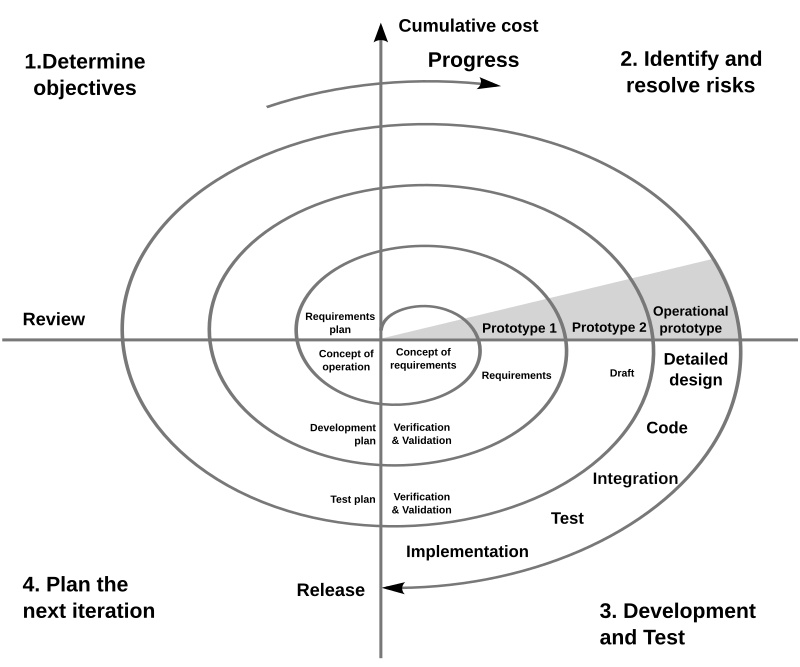 Source. Wikipedia
What it is. A risk-driven cycle: set objectives → analyze risks → engineer → evaluate; repeat, mixing methods as risks dictate.
Why it’s used. Makes risk mitigation the central driver; highly adaptable but requires strong risk expertise and governance.
Good fits (examples).
-
Large, complex, high-uncertainty programs (e.g., defense/aerospace platforms, platform modernizations).
-
Projects needing phased “specify → prototype → evaluate → refine” with explicit risk burn-down.
Based on: Boehm (1988/2002), IEEE Computer (Link).
Comparison at a Glance
| Model | Structure | Flexibility | Feedback | Risk Handling | Typical Use |
|---|---|---|---|---|---|
| Waterfall | Linear, once-through | Low | Late | Low (implicit) | Stable, regulated work |
| V-Model | Linear with mapped tests | Low | Moderate (planned tests) | Low–Moderate (quality focus) | Safety/mission-critical with V&V |
| Iterative | Repeat mini-cycles | High | High (each iteration) | Moderate (learn early) | Evolving requirements, R&D |
| Incremental | Deliver in slices | Moderate | Moderate (per increment) | Moderate (stage risky parts first) | Phased enterprise rollouts, MVP→growth |
| Prototyping | Build → feedback → refine | High | Very high | Moderate (requirements risk) | UX-heavy or novel concepts |
| RAD | Short, user-driven cycles | High | High | Moderate (fast loops) | Fast business apps, re-engineering |
| Spiral | Risk-driven loops | Very high | High | Very high (explicit) | Large, high-risk programs |
Tip: In practice, teams often combine models (e.g., incremental delivery developed iteratively, with prototypes and spiral-style risk spikes). Choose the mix that fits risk, volatility, compliance, and time-to-value.
Selected References
-
Boehm, B. W. (1988/2002). A Spiral Model of Software Development and Enhancement. IEEE Computer. (Link)
-
Larman, C., & Basili, V. R. (2003). Iterative and Incremental Development: A Brief History. IEEE Computer. (Link)
-
IEEE/EIA 12207.2. Software Life Cycle Processes—Implementation Considerations (Annex on once-through vs. evolutionary strategies). (Link)
-
SWEBOK v3. IEEE Computer Society (section on Prototyping). Software Engineering Body of Knowledge, Version 3.0. IEEE Computer Society (SWEBOK V3). (Link)
-
Falcão, R., et al. (2024). Experiences in Using the V-Model… (Springer chapter). Falcão, Rodrigo, et al. “Experiences in Using the V-Model as a Framework for Applied Doctoral Research.” Handbook on Teaching Empirical Software Engineering. Cham: Springer Nature Switzerland, 2024. 255-276. (Link)
Disclaimer: AI is used for text polishing, explaining and summarization. Authors have verified all facts and claims. In case of an error, feel free to file an issue.